
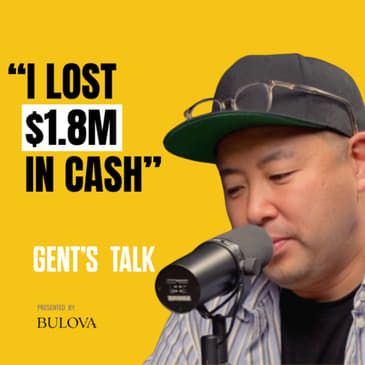
In this week's episode of Gent's Talk, presented by BULOVA & supported by Ninja Kitchen Canada, host Samir Mourani sits down with Antonio Park, a world renowned chef and entrepreneur to talk about what he learned from losing $1.8 MILLION in cash on a failed business venture, his upbringing, relationship with his parents, his approach to fatherhood and his model for success. #GentsTalk Connect with us! Subscribe here ► https://www.youtube.com/@GentsTalkPodcast Website: https://gentspost.com/ Instagram: https://www.instagram.com/gentspost/ TikTok: https://www.tiktok.com/@gentstalkpod Facebook: https://www.facebook.com/gentspost/ About Gent's Talk: The Gent's Talk series, powered by Gent's Post and presented by BULOVA Canada is an episodic video podcast conversation with leading gents and rising stars across various industries. Guests include Russell Peters, James Blunt, Robin Sharma, Director X, JP Saxe, Wes Hall, Johnny Orlando, Shan Boodram, Dom Gabriel, and Nick Bateman, just to name a few. The conversations range from career path, hurtles, mental health, family, relationships, business, and everything in between. Gent's Talk is the first-ever video podcast to be made available for streaming on all Air Canada domestic/international flights. We aim to have a raw, unfiltered conversations about our guests' lives, how they achieved success, lessons learned along the way, and the challenges encountered. Credits: Host/Producer: Samir Mourani Creative Director and Executive Producer: Steven Branco Video & Sound Editor: Roman Lapshin A STAMINA Group Production, powered by Gent's Post.
The Gent's Talk podcast, hosted by Samir Mourani, pulls the curtain back on difficult conversations around mental health, business, relationships and the difficulties around expressing oneself, with rising and leading gents from across the globe.
New episodes every Monday! #GentsTalk
Instagram: https://instagram.com/gentstalkpod
TikTok: https://tiktok.com/gentstalkpod
YouTube: https://www.youtube.com/@GentsTalkPodcast
[00:00:00] The love for food, that brings people together. I just want to do the best job that I can. Even if I'm as simple as a dishwasher, I'll be the best dishwasher. Antonio Park is a successful entrepreneur and world-renowned chef.
[00:00:14] A lot of people look up to you, a lot of people are inspired by what you do. They see the social media, they see the traveling, they see the restaurant, they see the work. Not all of them did well. Can we talk about that?
[00:00:25] That's the best thing that happened to me. Why? Last year I opened the business and in six months, I lost $1.8 million cash. Are you okay with that? Am I going to be the guy who's going to be hiding in my couch? No, you must stay positive.
[00:00:40] You don't learn much from success. What's the backstory here? I think all these things that came in my life made me who I am today. The relationship with my father was... was no relationship.
[00:00:56] What I mean by that is my father was there, but he never spoke to me. He never said, I love you, not even once. My mom never did either. What have you learned from being a father today that you wish your father did more of with you?
[00:01:33] Chef Antonio Park, I am so excited to have this conversation with you. Thank you for coming. Thank you for having me, Samir. Now that we've got the formality out of the way of like chef and host and all that stuff,
[00:01:45] we were talking about before we started recording what to formally call each other, but I feel like we're already friends. So Antonio, Samir, Samir, Antonio, you have an inspiring journey. A lot of people look up to you. A lot of people are inspired by what you do.
[00:02:00] They see the social media. They see the traveling. They see the restaurant. They see the work. What's the backstory here? Where did this all start? It all started... Wow. Wow. That's a long story going back. It all started when I was probably around seven years old.
[00:02:20] My parents, obviously, you know, born in Argentina, grew up in Argentina, Paraguay and Brazil, and South America and Argentina. My parents used to have a business called Lavanderia. Lavanderia is a laundry mat where they used to do floating, assy stone wash jeans.
[00:02:38] So in the 70s and 80s, you remember like Ryan Wrangler? Yeah. They used to have these spots on the jeans. And that's what my parents used to do with their team, their staff.
[00:02:50] We used to have about 50 to 100 people, depending on which week it was, which month it was. We always had 50 to 100 people working in-house. That's not a small operation. No, that's like 60,000 washes a day by hand. You have to step on it.
[00:03:06] You're like stepping on it, putting on a wooden wheel, washing with the stones and then bringing it back and putting on the sun, on the metal wire, hanging all the jeans. It has to be metal wire because jeans are very heavy. Okay.
[00:03:19] So yeah, you have to kind of hold it in. You got to hold it in. And we used to have acres of land in the back. But the thing is every day, breakfast, lunch and dinner and like snacks, we all eat together.
[00:03:32] My mom used to cook with her staff and with everybody was there. She used to cook meals every day from morning till night, working and cooking at the same time. It was a beautiful world.
[00:03:46] And she used to have a farm in the back of the La Vendiria, which is pretty far, but you have to take this one wheel, like kind of like trolley. And put all the vegetables in it.
[00:03:59] And she used to have a little farm in the back and we used to cultivate everything. Obviously, it's beautiful temperature, very warm, very sunny. So, you know, vegetation is very, very easy. Agriculture is very easy on that.
[00:04:09] Easy saying it's easy to go and pick it up, but it's not easy to water every day and make sure that the work that goes into it.
[00:04:16] And I was in charge of, since I was like six years old, I was in charge of going there and picking up things. Making sure that I choose the right onions, garlic, cucumber, watermelon, carrots, mango, you name it. There's bananas, there's a bunch of other things.
[00:04:34] And I used to, you know, my mom used to cultivate all that. So I used to pick them up and put them in the trolley and then bring it in. And then they used to cook with that. So that's where it really started, right?
[00:04:45] I saw all this vegetables growing from ground and, you know, I used to just pick up an onion and just open him up, smell them, eat them. I remember cucumber, it was like, why is this cucumber growing so fast? Do it that way.
[00:05:07] And just learn from my mom how to get it from the source. Learning from seeing it, how it grows, learning in how they can be fresh, how you cultivate them, how you water them. Does it have to be exposed to sun, not exposed to sun?
[00:05:28] So it's basically, I was a farmer. Real education. Yeah, a real direct education and she used to tell me, you know, like, this is not ready yet. Why did you bring this here? This you should have picked yesterday.
[00:05:43] And she used to tell me these at the age of seven and eight. Not in a bad way, but you know. To teach you. But the pain of going back and bringing it back. Made you learn very quickly.
[00:05:54] So that's where we're kind of like the passion, the love for food, for vegetables, for anything that it has to do with cooking. Because I bring the vegetables and then my mom is butchering her chicken, you know, filleting her fish and things like that.
[00:06:13] And I watched them and I helped them out. I helped them not on filleting things, but peeling the garlic, you know, peeling the onions. Is that where you developed your love of cooking? That's where I developed the love of cooking. And from there you just...
[00:06:27] It was just, it was like, you know, if you have 50 to 100 people every day eating together and cooking together, basically that's a restaurant. Yeah. Every day. Very much, yeah. Yeah, every day. So, and it's breakfast, lunch, dinner. So it's a full breakfast, full service restaurant.
[00:06:47] Obviously self-service because you clean your own thing, you know. I'm not gonna clean your shit. So, yeah, it was just learning how to marinate things. It was very basic traditional Korean food that she used to do and then slowly got involved with the South American cooking.
[00:07:08] We used to buy a quarter of a cow, put it on the fire and slowly roast during the whole day and then at night we eat that. Yeah. I remember, you know, boiling, burning myself on grills all the time and we used to steam yukka.
[00:07:27] I don't know if you know what yukka is. It's called mandioka. Okay. It's a root. Okay. Other people call it kasaba. It's kind of different. Yukka, mandioka and kasaba, kind of the same family but kind of like different also. Okay. Different sweetness, different flavor, different size. Yeah.
[00:07:46] But we used to call it mandioka over there. Yukka is a language that comes from guarani and we used to eat that with the meat and a simple salad which was just lettuce, tomatoes and onion.
[00:08:00] The vinaigrette was oil, salt, pepper and a little bit of limon which is lemon. It's funny when I came here, I was like, oh, there's lemon in lime. But in South America, in Argentina we have limon but we don't have lime. That was a bit funny. Yeah.
[00:08:21] But it was pretty cool and that's where my passion grew more and more, eating with them, conversation, bringing the crew together. I think that's what a lot of things happens in the restaurant system where we call it a restaurant team. We call it a family.
[00:08:38] A lot of restaurants don't have staff meals. A lot of people don't eat together during staff meals. I think those are very important cultures to cultivate because... Workplace cultures. Yeah, you sit down and you eat together. You talk about life.
[00:08:56] Sometimes it's personal life but you know, life, talk about life itself, experiences in life, what you're doing in the future, what you did yesterday. And that brings people together.
[00:09:07] And I try to do as much as I can, obviously, very busy times but I want my team to always have a staff meal together and be together and spend time together. It was a really nice thing. I worked in the restaurant business briefly, like three years.
[00:09:26] And we didn't do staff meals. And I found, when you talk about that, it certainly brings people together. When you break bread with someone, that's how you really get to learn them. That's how you get to know them.
[00:09:43] And if you're the one leading that, it also makes them really want to be part of this. Be part of the family. Yeah. So I think it's really inspiring that you do that. It's not very hard to do by the way because you're eating at home.
[00:09:58] And that's a lot of the things that's kind of like, I feel sad about what's going on today. Life took another step. Work took another step in our lives.
[00:10:12] And you know, I remember when I was a child, in my early, you know, before 10 or even until before I was 15, you know, it was always family meal. You cannot miss your family dinners. That was like, you miss that? You're getting a hell of a whip from that.
[00:10:32] But those things doesn't really exist today as it used to exist 30, 40 years ago. Even 20 years ago I think it existed. And I'm trying to bring that back. I'm trying to do everything that I can to bring that community back, that family back together.
[00:10:47] The relationship that I used to have with my grandparents. I want my children to have the relationship with my mother. And it's very hard to connect that these days. Obviously social media took a huge hit on that and came in a different way.
[00:11:03] But like, we have our, somehow today there's specific days that you're going to have your family dinner. Thanksgiving, Christmas dinner. But there's not a lot of them in between. But that's supposed to be every day. That's everyday life for a family.
[00:11:23] Because that's how you get to know the other person that is in front of you more. I might not know the names of probably 90% of my clients. How could I know all of the customers that I have?
[00:11:37] But how about if I tell you, I know maybe 10% of their names. But how about if I tell you I know 70% of their dietary restrictions? Isn't that funny? So I don't know their name but I know what they like, what they eat.
[00:11:51] You really get to know what their children like. So they're like, I might not know your name but I do know you. It's like really fun. I find it exciting. I find it fascinating. And I also find it very important to know that side of human.
[00:12:11] So before you became the chef that's sitting in front of me today. When you started off your career, what was that process like? You started working in the food industry. Dishwasher. Dishwasher, worked your way. Yeah, worked my way up.
[00:12:28] I don't know if that was the way that I was thinking. I'm gonna work my way up. My life was never like that. My life was like just put whatever in front of me and I'll just try to do my best. I won't complain.
[00:12:43] If anything as simple as a dishwasher, I'll be the best dishwasher. If I have to clean the cups and clean the wine glasses, clean the tables, clean the dishes, clean the fish, harvest something. I just want to do the best job that I can.
[00:13:04] And that kind of like translated into the business model that I have today is not... There's 24 hours in a day. That will not change. I had a very deep conversation one day, the first time that I made a very close friend of mine. And I still remember this.
[00:13:26] I was in the basement of my restaurant, the first restaurant that I opened. It was the first year that I opened. I went downstairs in my basement and it's like a storage where we put like Coca-Cola and beer storage, right?
[00:13:37] I sat down one chair like this after service with Antonio Sfandiar as fundiar. I don't know if you're not Antonio Sfandiar. He's a poker player. They called him the magician and we had a moment together. And I told him about what my life was and things like that.
[00:13:55] And certainly throughout along the way he kind of helped me in different ways to understand the things. He kind of like put me the message of the 24 deck of cards. So the 24 deck of cards means the 24 hours of your one day.
[00:14:17] You put aside the six hours, the eight hours to sleep, rest, clean up and do things. You put two hours for eating. So if you play the deck of cards really well in your life for the 24 deck of cards,
[00:14:32] then you're kind of like systemizing your life and living it in a good way. But it's not easy, right? It's not always easy to say, okay, I'm going to eat at this time. That's how you know. Yeah, life throws you a curve ball.
[00:14:46] But if you have fundamentally an idea that your 24 deck of cards is 24 days and you put aside certain deck of cards that is important for you, it's going to make your life better and easier. And that's the way you live your life today.
[00:15:03] I try. It helps me a lot and I always think about it. Just the fact of thinking about that, it's already a good thing. Because if you're not thinking at all. Well, not at all. It's a different problem.
[00:15:14] But it sounds like you're a lot more intentional with the way you plan your days. I have to. Well, as you get busier. It's just better for me. But at the same time, it makes me a better person.
[00:15:26] So we are, I always tell to people like, dude, we're like, oh man. You're, yesterday was yesterday. Today is today. Tomorrow is tomorrow. But yesterday is the past. So today you should be better and tomorrow you should be even better.
[00:15:49] So if you live your life in that motive, then you are going to become a better person. Such as a very clear example. When you were born, you can't turn. You're just laying down and then you start turning and then you start crawling.
[00:16:07] And then you hold something and you step up and then you start walking and then you start running. So even baby and children do that with the progress of getting better. We as an adult, we all know more than that.
[00:16:22] So how can we not learn from our past what happened and just become better in the future? Absolutely. Such a simple thing that you think about and you go, oh, okay. There's a way there's a path to becoming a better version of myself. How do you balance?
[00:16:38] So maybe before I ask that question, can you sort of list off all the different ventures you currently have going on? Oh, because I want to showcase that and then ask you how you balance all of that. I have a little bit with story.
[00:16:57] Obviously there's things that happen throughout the life. But I opened Park right after opening Park. That was in 2012. We're going on our 13th year. Congratulations. Thank you. I'm just pushing my team is great. My family is great over there.
[00:17:15] Just is a tremendous happiness to me and think that I will never even imagine that this could happen in the future. And I'm very grateful and I'm very thankful. That's putting aside that I opened my second venture kind of like, you know, different way.
[00:17:34] I got into a supper club business that's called Fly Jean in Montreal. So understanding the night life and the day life with the food. I got to learn a lot from that, by the way. I also got to learn in many different ways. The camera went off.
[00:17:55] We'll go on the cameras? Yeah. Okay. Sorry to say that. No, no, that's good. Thanks for asking. I learned a lot of the system of clubs and night lives are in the basement. Okay. What do you mean? A lot of clubs are in the basement.
[00:18:22] Oh, I see what you mean. Yeah, yeah. So they're more darker, you know, soundproof and all that. And I was thinking always in my head how would my boys, my team, my boys and girls and my team do things in the basement.
[00:18:39] So basically you're going to work in a basement. It's not fun. Doesn't sound fun. Yeah, it's not fun. But after I have a chef came there still today after 10 years and he's still there.
[00:18:52] So I'm very thankful and I'm like, I plus them, you know, for doing what they do. Just a corner story that I wanted to talk about him because I'm just, he's just been a rock for me.
[00:19:07] And then after we opened two restaurants kind of together, it was Chitoba and Lavanderia. Lavanderia was out of the memory of South America, Argentinian food, brunch, lunch and dinner. That was just out of passion. Somewhere where I wanted to go eat all the time. Yeah.
[00:19:27] I want to go to Sado, chorizo, Parilla completa, mojegas, chinchulín, morcillas. There's certain things that I want to eat, chipas, the cheese bread. So I opened out of that memory from South America. I just opened it and then I opened Chitoba. I had a chef.
[00:19:49] His name is Olivier Vignon. He was my sous chef prior to Park. I used to work in a restaurant called Kaizen in Montreal and he was my sous chef. And he also became CDC chef decreasing at Park.
[00:20:04] And at one point you realize that your student is becoming better than you. So when somebody becomes better than you, you have to give him wings to fly. You cannot keep him. So I decided to open a restaurant for him with him together. He's a partner today.
[00:20:22] He's been there for 10 years also, almost 10 years. Wow, that time just flew. It's a very unique way of doing things, empowering another person. And I did an overstep by the way. And that's a lot of the mistakes that a lot of people do.
[00:20:38] They overstep because they believe their ego comes in before. And so they think they're superior than others but nobody's really superior than others. We're all the same. We're all afraid the same air. Nothing should make a difference on that. And he became a rock star.
[00:20:58] He's a great chef and hands down he's better chef than me. I know that. And that's what I want. That's what I love the most is that I always look at young chefs. And all the chefs will stay with me by the way. You know what happens, right?
[00:21:14] Everybody has their personality, their life and their different ideas, their ambitions and they go different ways. But those who were with me, I always told them this. My goal and my wish is for you to be better than me. How could you not be better than me?
[00:21:31] You want to learn something? I give you everything you want to learn. On top of it, your knowledge comes on top of it. So you automatically should be better than me. If you're not better than me, then for me that's a failure. You have to surpass your master.
[00:21:48] I'm not a master but I'm a teacher. I'm a mentor. I'm somebody who's... I learn also from them by the way. This is the real fun part of it. Is that you are teaching something to them but later on that teaching comes back to you
[00:22:04] and you learn from them. That's the real beauty of humanity and also the real beauty of being a chef and being a cook in the kitchen. After that, we open another place called Kampai which is a beer garden. And then... I can't keep on pushing.
[00:22:27] I opened a food hall in Montreal called Cathcart at the Placeville Marie. Now I'm just confused. I'm just everywhere. I opened a restaurant in Seoul, South Korea called Santre and then I opened West Food in Laval, AP in Toronto, PIC6 in Toronto.
[00:22:55] Not all of them did well by the way. I have failed. Can we talk about that? It's the best thing that happened to me. Why? Because you learn. You don't learn much from success. You can't... I always tell my children... My eldest one is 17 years old today.
[00:23:16] He's Alexander Park. My second daughter is 16 years old. Naomi Park. And I always tell them, go to places where it's not great because if everything is great you won't learn much. The places where it's not great and small you'll learn a lot more
[00:23:37] because you're going to make a lot of mistakes like they did. And by making mistakes that's where you really learn the progress of becoming better. So what was the biggest thing you learned from... How many quote-unquote failures failed ventures from those ones?
[00:23:57] What's the biggest lesson you've taken away from them? I failed. I failed. Some of them I failed dramatically. And I'm not... Everybody says, don't take it on you. It's not all your fault. But at the end of the day I take it as everything is my fault.
[00:24:18] Because it's my project. Even if you say our project with our project if we did well then we did well. But if we failed, I take it in and I say I did not do well. Depends on how people digest things. Depends on how people take it.
[00:24:38] I like to take it that way. I like to take the heat and I like to... I've lost a lot of money by the way on losing these businesses. And does it hurt? Yeah! Dude, of course. Of course. Big time. A major. Ego, money. Major, yeah.
[00:24:59] Reputation and all that. We're... And I've done a lot of things that became very successful. But I've also done a lot of things that I failed a lot. For instance, a very simple thing. Last year I'm not going to name it. Obviously, I have other ventures
[00:25:16] that I kept on doing it. But last year I opened the business and in six months not even in six months probably. Yeah, in six months. Let's say plus or minus six months. I lost $1.8 million. Cash. My own money. And... Am I going to be the guy
[00:25:35] who is going to be hiding in my couch and saying, Why did I do that? I lost them. No! You can't change the past. I keep on saying this. You can't change the past. You can change today and tomorrow. You can learn from the past.
[00:25:54] You can be better than the past. You know? So, you learn from that mistakes. And then you move on forward. The idea of losing $1.8 million in six months and moving forward. How do you think of it? Dude, I went to a very expensive university for six months.
[00:26:19] That taught me the real life on things to do it. Let's go ahead looking at it. Yeah, it hurts. It still hurts, by the way. I can't say it doesn't hurt. But will it be something that's going to stop me from moving forward? Absolutely not. No, that's...
[00:26:38] So if someone is listening to this or watching this, is looking at getting into an entrepreneurial venture, whether in the hospitality industry or anything for the matter, because this lesson transcends all industries here. And they're about to embark on something and they have to take that risk.
[00:26:56] What would you say to them? Take that risk. How do you... You don't know the future. There's people tell me, yeah, don't partner with them. Don't do this, don't do that. Don't do this, don't do that. At the end of the day,
[00:27:14] either you're going to do it or not. There's two answers, right? Either there's no in between. It's either you do it or not. If you do it and you've succeeded, good, move on. Try to make it better now. If you fail,
[00:27:30] there's a world that says do not give up. When it comes to business and money, if you're bleeding a lot, give up. There comes a time when you should just... Just close the books and find something else and move on. Because if you keep on bleeding,
[00:27:52] a sinking ship is much harder to rise it up above the water than having a boat that is already on top of the water and making it stronger and stronger. So the way that I see it is, I'm not going to be...
[00:28:07] I don't have the answers to everything, but if you're bleeding a lot in a business and you're stressed every day, you can't sleep, you're not being a good father, a good husband, a good wife or anything, move on and build something else.
[00:28:25] That's not really giving up on life. That's giving up on that small business. How do you build the emotional resilience to come back from that? I mean, when you talk about losing $1.8 million in cash, that's money that some people will never see in their lives,
[00:28:42] so when they hear that number, they go, holy shit, that's a huge number. You're sitting here with a smile on your face as you tell this story. How do you build... I'm broken here. How do you build the emotional resilience to move past that and go,
[00:29:00] I'm closing the books on this, I'm going to start something else? It's just every day being positive. What do you say to yourself? I woke up this morning, oh, I'm still alive. Let's move forward. I'm not dead. That was just a mountain
[00:29:22] that you just climbed and you came down. Let's climb another mountain. In business, to me, the way that I see businesses, and I'm talking about restaurant business, in a restaurant business, it's like a box of milk. It has an expiry date to it.
[00:29:48] You do not know when the expiry date of your restaurant is, but there is an expiry date to it. It might be an institution for 30, 40 years, but it's still 30, 40 years expiry date on it. That's a restaurant business. Restaurant business is a very fragile business, by the way.
[00:30:07] The customer can be happy 100 times, have the best time for 100 times. If the 100 first time was his worst service, his worst food and everything, that person might not come back. And then go tell their friends about it too. Yes, and it's very fragile business.
[00:30:23] You have to be always on top of your game. Most importantly, you must stay positive. Because if you're not positive, all those things are going to pull you down. Pull you down to the ground. This summer, it's about creating unforgettable core memories with the ones you love.
[00:30:42] With Ninja's lineup of outdoor appliances, you can feel confident outdoors and own the summer with your favorite people. The Ninja Woodfire Pro Connect XL Outdoor Grill & Smoker lets you monitor and control your cooking right from your phone. With 30% more space, you can minimize time spent cooking
[00:30:57] and maximize time spent making memories. Reimagine outdoor cooking with the Ninja Woodfire 8-in-1 Outdoor Oven. From no turn, no fuss, pizzas to perfectly charred steaks in under 7 minutes, enjoy all at the touch of a button. Relax and savor every moment while your food cooks to perfection.
[00:31:16] Own the summer and simplify your outdoor cooking and entertaining and create cherished memories with Ninja's outdoor appliances. Check out their outdoor line on ninjakitchen.ca How do you identify a good business opportunity? What's your process? When someone approaches you about an idea
[00:31:34] or you're coming up with an idea for yourself, what are some of the things that you do to come to the conclusion of this is a good idea or it's nice but it's not going to work? In the restaurant industry, it's a little bit different.
[00:31:47] The other, in the tech business and things like that, obviously you have your technology that is moving forward. There's some investment that I did on artificial intelligence and AI is the future for me and it's going to move forward. That's an investment on the long term.
[00:32:04] But on the restaurant business, you don't know. You don't know until you do it. You might have the best chef in the world with you. I'm considering myself right now when talking to you as a business entrepreneur, not a chef.
[00:32:23] So let's say I find the best chef and the best manager in the world and let's say I open for what I believe it's going to be the best restaurant in the world. If that relationship doesn't do well, you failed.
[00:32:41] If they don't have the understanding of food cost, labor cost, the back end, all the expenses that goes in the restaurant, you have failed. So today you have to be a little bit more than just a chef. You have to understand the business. To be an entrepreneur.
[00:33:02] To be an entrepreneur. But a restaurant, at the end of the day, a restaurant is a passion business. Yes. It's not really a business business business. It's a passion business. There's some structure that you make it to become a business such as franchises, multiple businesses,
[00:33:21] or you create a different way of opening yourself to create multiple brands. That's a different story. But when it comes to one restaurant yourself, that's a passion business. But still that passion business today because of what happened after the pandemic.
[00:33:40] Before the pandemic was showing us a little bit, but after the pandemic really hit us with labor cost increase, tax increase, rent increase. The food cost. It's got rocketed. The food cost just went up. So the margins what we used to make pre-pandemic to today
[00:34:02] is probably half of what it used to do. So it's at the end of the day, you have to think well what you want to do. And the other thing about the one restaurant that you want to open with the best chef
[00:34:16] and the best manager is how much time are they going to put into that? But in today's world, time is no longer what it used to be. They don't want to work from 8 a.m. Nor me, nor you. Nobody wants to work from 8 a.m.
[00:34:34] Till 8 p.m., 9 p.m. Till midnight. Yeah. 9 a.m. till 1 o'clock midnight. Who wants to do that anymore? So you can say, oh yeah, like that person. As a self-owned business, if you're the owner and you're living there, it's okay, you're living there.
[00:34:56] Your mother is in the kitchen, your father is in the kitchen. They love that. They love to do that, make people happy. That's one business and you can survive and make a family business out of that. And it's beautiful, by the way.
[00:35:08] But if you're going into the restaurant business to make money and to have other intentions in the future, it's a wrong business. Interesting. So it sounds like you're saying anybody who wants to go into making money in the restaurant, like anyone who opens up a restaurant
[00:35:30] is doing it for passion, not for money. And if they're doing it for money and then passion... Well, it's two different things. If you're doing it for money, you have to do for money. Corporate. I see the franchise model. There's this model, right? Which is also very good.
[00:35:46] But this you have to really understand the business side of it and how to grow. And you need a good funding. You need a good backing. A lot of upfront capital. Yeah, you need a good backing from behind because you have the marketing plan, PR plan
[00:36:00] and all the other things, the training. So there's a lot of things that comes with it. But if you want to open one restaurant where is a mom-and-pop shop, a lot of people do it. So artistically, right? That works. That works. Can mom-and-pop shops survive today?
[00:36:17] Absolutely they can. Why? If they put the hours. If they overwork. They have to overwork. Mom-and-pop shops cannot work. And first of all, it cannot be called mom-and-pop shops. If mom and pop is not there with their children. There, yeah. Or their cousins. Or their nephews. Yeah.
[00:36:38] It literally has to be a family business. Yeah, and that works. That will make you will make a living out of it. Absolutely you'll do. But to open a big restaurant where you're putting in. It's not everybody has the same idea
[00:36:51] as you where you want the restaurant to succeed for a lot of the people out there. They want to succeed, but they also want them to succeed. Yeah. So you're not in the same page, right? Which I think is an important distinction to be made
[00:37:09] because when you're the entrepreneur, you're the one taking the risks, you're opening up a new venture. Your reason to succeed is your livelihood. For some people who come and join you on this journey, their version of success is, you know, two weeks I got a paycheck.
[00:37:25] And that's it. And to be fair, there's also nothing wrong with that because that's what they want. You're living your life. That's why I say they have their own life to live. So the owners of the restaurant have their own life to live
[00:37:37] and their own dream to grow. But the person who's working in there, which I was one of them before and we were all one of them before, we also have dreams that we want to do something else in the future.
[00:37:49] But for me, this is where it becomes really interesting. If you're working somebody, if you're working for somebody and you believe in that owner or that boss, work better than him. If you're a dishwasher, be the best dishwasher.
[00:38:11] If you're a commie, be the best commie in the world. If you're a sushi, be the best sushi in the world. If you're a waiter or a bosser, be the best waiter and the bosser in the world. Then when you'll be somewhere in the future,
[00:38:28] I promise you this, you will 100% be somewhere in the future because you have the right motives. You have the right positivity to go forward and to go forward somewhere where even the owners are not there yet. And one way or the other, when you need cash
[00:38:47] and when you need money to build your own successful business in the future, they will be there to back you up because they've seen you do the effort that you're putting it in. So it's not very difficult, by the way. Success is sometimes,
[00:39:04] doesn't have to start from you. It can start from somebody else. You make them successful. You stand behind them and you surpass them in the future. Interesting. It's an interesting model and it touches on the model that you talked about earlier of giving wings to the...
[00:39:26] The students who are becoming better, yes. Of course. They approved it. Why would I not do that? There's not even a blink in my head, right? Instant. Man, this guy is working his ass off. He's amazing. Let's fund him. He has a dream. Let's fund him.
[00:39:46] How do you... You talked about your kids. How do you balance all of these different business ventures and also being a good father, a good husband, a good employer, a good entrepreneur, a good human, like all of... And then also time for yourself. That's such a...
[00:40:06] That's like the hardest question. First of all, I... I'm an okay father. I try to be the best father that I can. I cannot be always for them. I try to be as much as I can for them.
[00:40:24] So I won't miss the important days that they have to. Because if I miss the important days, they'll miss the important days later on when they grow up. You know what I mean? There's a deal there going on. That was the thing. But balance in life,
[00:40:39] when it comes to restaurant, there's no balance. If somebody tells you there's a balance when you're working in the restaurant industry and home, children, girlfriend, wife, husband, boyfriend, work... No, fuck that. There's no balance. No, absolutely not. Impossible. Are you okay with that? I'm not okay with that.
[00:41:08] And I'm trying to change that. More and more time goes by, I'm trying to organize those 24 deck of cards in the right position and play the cards right. And towards more, towards family today. Why do you think you're an okay father? I think I'm an okay father
[00:41:27] because I don't spend as much time as other fathers do with their children. For the time that you do spend with your children, is it quality? It's very quality. I spend time with them. I don't... Well, there's not much, right?
[00:41:43] So I have to spend quality time with them. I always ask the questions, even if it's the same questions, even if it's the same things that I say, there's always that I said since they were born till today. It's never do something
[00:41:56] that you don't want others to do it to you. And I keep on repeating this every single day because it's important. I want them... This is one message that is... for me, is one of the most important messages. And the other thing is I always ask them
[00:42:15] the basic things of life. Obviously, yes, I spend time with them. You know, I was doing the... I was sanding the floor with my son for the deck last weekend, painting together. Those are times that... Because we work together, we talk together. And by doing that,
[00:42:37] we keep on asking how school, how's everything. I always ask about school. I always ask about food. How you're eating, what you're doing. They're very interested in food too. So I'm very thankful about that. Conscious about what they're eating. It's a very difficult world.
[00:42:57] I have four children today. All four of them eat kind of different. They all have different dietary restrictions. So I get to learn a lot from that also. The new era, the new generation of what the children is today. And I don't blame them. It's a customer base.
[00:43:15] Yeah, I don't blame them. Some lactose intolerant, celiac, vegan, meat lover. Let's go! But I try to be a good father. But I am not... I'm a very straight father. They can't play the game with me. So that's kind of like...
[00:43:46] It comes from my childhood, my father also. I was going to ask you what your relationship with your father was. My father... The relationship with my father was no relationship. What I mean by that is my father was there, but he never spoke to me.
[00:44:00] He used to say... Throw words once in a while. Never heard from my father until he died. Never heard he... He never said, I love you. Not even once. My mom never did either until my father passed away. And I told my mother about that.
[00:44:18] And then she's like, oh, there was a little guilt. But my mother is... You know, my angel. She's everything to me. She's giving me my life. And I will not blame on my father how he treated me or what he did to me.
[00:44:35] There was a lot of violence at home. My father was a very violent man. He came from a military background. How did that affect you? It made me stronger, actually. My father really made me stronger. He beat me up and just became more stronger.
[00:44:53] So that's why I think all these things that came in my life made me who I am today. The hard times of, you know, violent father. Father who wasn't really into the son. He only cared about me going to university and studying hard and things like that.
[00:45:15] He hated me going to work in the kitchen. Hated, hated, literally hated. My mom always was the support behind saying, you know, it's okay. My mom was the one who was always healing me after I got beat up by my father. That's another thing.
[00:45:32] But I don't blame them. And I don't want to go like, you know, a lot of people say, but, you know, maybe your past has anything to do with your father who was violent to you and things. No, it made me stronger. That's how I see it.
[00:45:58] I want to take myself and put it in a positive way. Is it stronger or resilient? Yes, that's the word. Resilient. But also stronger. Strong-minded. Strong focus because when I want to do something I go for it. Now that you have a son,
[00:46:14] is it one son that you have? Two sons. Two daughters. So as a father today, looking back on how your father treated you, is there anything that... How do I want to phrase this? What have you learned from being a father today
[00:46:32] that you wish your father did more of with you? Spend more time, talk more. Tell me more about his past. Have a relationship. Relationship. Yeah, what was hard was... If I had something, if I had my father in front of me today, I would ask him like,
[00:47:00] I want to hear your life story. I want to hear what happened. I want to hear what... Because it's like nothing. I know parts of it because my family talks about it, my aunt talks about it, my uncle talks about it and things like that.
[00:47:20] My mom talks about it, but I never heard from him. So I don't know his real feeling towards what he did in the past. How was his childhood? How was his school years? He was a great athlete. How did you end up becoming a great athlete?
[00:47:36] You used to play professional baseball. How did you do that? I wanted to get into his brain and that's what I do today with my children. First of all, I tell them I love them 20 million times a day. But I also open up the book
[00:47:52] to them and I tell them what the mistakes that I've made and what I'm going to do, what I did well and is still doing good and just keep on pushing them towards because I believe that I'm their first teacher. You are...
[00:48:10] As a father, I'm my children's first teacher. So as a teacher, I should give them guidance. I should teach them pave the road for them. And sometimes the roads are not always properly paved. I should teach them how to be sometimes. And I want to also show them...
[00:48:28] Most times it's bumpy. And I tell them, it's bumpy. It's going to get bumpy. It's up and down. But I want to be real to them. So I tell them that. What are you hoping your sons take away from you so that when they have a son
[00:48:44] and they want to teach them something, what are you hoping they learn from you? To be better than me. To be always better than me. To tell them and to change and to be opposite of that. Because that's what I'm doing towards my kids
[00:48:58] from whom my father was how he treated me. I'm doing the opposite towards my children. You want them to continue to sort of learn to be a bit more compassionate with their children? Yeah, yeah. More compassion, more understanding. But also
[00:49:14] there's one thing that I didn't let go from my father and I'm still continuing with my children is discipline. For me, that's very important. Obviously I come from my parents. My both parents are South Korean they're Korean parents so they're very disciplined.
[00:49:30] The structure is like one is one. One is not two. Well sometimes my father would say one plus two equals four and it is four. And I would say, ah yeah, okay, sure. Like yeah, it's four of course it's four
[00:49:44] but I tell them if I'm wrong, tell me I'm wrong. I'm not telling them I know everything I'm telling them, you know I'm willing to listen to you and share my thoughts with you too. It's very important. Yeah. So it's
[00:49:56] like I don't want them to say, you know we all know the story right? When the kids are born that is Superman. They get, you know when they're kids growing up three, four, five years old, seven years old that is the king. He is the best
[00:50:12] he is my hero is that and then after when he turns into 1213 yeah that is okay. He knows a little bit at the age of 15, oh that knows nothing and then like I know everything and then he goes back and then when they become older they say
[00:50:26] well that knew a lot of things, you know that knew a lot of things. My dad knew a lot of things but resilience, yeah he gave me resilience but he gave me discipline which I will never let that go discipline and the most important
[00:50:38] thing about my mom and my dad is they gave me life. So there's a sense of gratefulness and gratitude for for that. If you can go back in time and speak to a young Antonio the one that you know I know you talk about it
[00:50:58] made you tough and gave you sort of the strength and resilience that you have today but I find it hard to imagine that there wasn't a point in time when a young Antonio looked up to his dad and said to himself, you know
[00:51:12] I wish you would just talk to me. If you can go back and speak to a young Antonio what would you say to him? Talk to him. Yeah because I wasn't that person I was also like scared is mostly being afraid of your father
[00:51:30] so I was never able to connect with him because I was afraid and if I was talking to the young Antonio today I would tell them you can go talk like you don't there's nothing wrong and asking me questions
[00:51:50] and even if he beats you up keep on talking so that's one of the things that I do with my children is open up tell me You encourage the conversation Yeah Say it No problem because there's no violence so they will talk about it I'm scared
[00:52:12] In my life it was it was violence I'm not going to go there I might get beat up again It's an interesting backstory because I could see how it shapes who you are today I'm curious what do you have coming up these days
[00:52:32] What are you working on right now? Oh my lord What's the most pressing thing that you're super excited about? I'm excited about Toronto, I'm excited about the Yorkfield murals There's an event called Yorkfield murals and Alan the head of the event my manager Andrew Kelly is my manager
[00:52:58] he's a great manager friend, manager, agent everything in me and for the first time ever in Toronto we're doing a dinner on the street of Yorkfield with an artist called Dan Femme from Dallas I just had a meeting today with her her art Dan Femme, very amazing artist
[00:53:30] when you look at her art I always think of her today you're from Jupiter or Mars Pluto, I don't know because her art is very special so we're collaborating art and it's about I want to tell I like to do a little bit different
[00:53:50] I don't want to tell my story about food because it's Yorkfield murals it's about artists I want to talk about their story through food today's question was what do you love to eat what would be the last food you want to eat before you die
[00:54:10] what's the food that you eat the most so I asked all these questions and I'm going to make a menu out of it and use her art to be a part of it wow it's the first time ever there will be a dinner on the street of Toronto
[00:54:28] very exciting the licensing and permits situation sounds like a headache to me we can't we'll talk about this after the event and then the other thing that I have is I do have a couple of adventures happening in Europe Middle East Middle East
[00:54:56] a lot of things shaking over there I like there's the possibility which we're already in conversations in different ways Dubai, Riyadh and Morocco there's a lot of talks in there we're moving forward in a bunch of things over there for expanding the business and also the states
[00:55:22] Las Vegas Chicago Texas and this year September when are you guys airing this? this will be in the first couple of weeks of July ok so if you're listening in July perfect timing because Montreal has its first President's Cup this year is the President's Cup, the PGA
[00:55:48] President's Cup in Montreal at the Royal Montreal and I'll be taking care of I'm very excited for that for the FMB for the athletes family team, friends and the PGA I'm very excited for that I love that so I'm bringing a couple of friends
[00:56:12] I want to do work together and more and more what I want to do in the future and what I'm positioning to do 35 years industry I've made a lot of friends in the restaurant industry and the hospitality industry and wherever I go in any city or any country
[00:56:38] in the world where I go I want to bring my friends and do events together open restaurants together because it's stronger together and it's more fun together so I want to do that and by doing it together there's also this positivity and synergy that grows within your friends
[00:57:00] and just to give you a heads up there's a lot of events coming at AP here at the Manure Life Building I opened the restaurant called Antonio Park not my fault I didn't put that name though as my partner decided to put my name on it and
[00:57:16] I am doing a monthly collaboration dinner called Align the Stars we already did with Mon Bar in Barcelona amazing restaurant the second event that we did with Casama Chicago the first Filipino restaurant the first Filipino restaurant that has a Michelin star in the world they're just
[00:57:38] you know, Ginny and Timothy they're just amazing chefs they're amazing people and then the third event that's coming in is from Sao Paulo a restaurant called Evai my very close friend Luis Felipe who had one Michelin star probably the best restaurant in Brazil
[00:57:58] and he just got his second Michelin star just a couple of weeks ago if you're watching I'm proud of you I love you and I'm so thankful that he accepted to come to Toronto and do a dinner together at AP together with me collaboration with Evai
[00:58:18] these are the things that I want to do I want to collaborate with my friends you know have fun, enjoy the times and not only collaborate do events but also grow internationally in the platform of business I think there's opportunities out there instead of there's opportunities that's happening
[00:58:40] especially in the Middle East right now where they're not building out one hotel they're building a city so when you build a city for instance in Riyadh they're building I don't know if you know about this Riyadh there's a big city that is building
[00:58:59] it's a whole city that they're building and I'm in talks with them and I could basically bring 50 of my friends and open 50 different restaurants there that's an opportunity but that's an opportunity where I get excited because I'm so excited to bring my friends together
[00:59:19] with me and do this together it's like let's not grow alone let's grow together as a team as a family hey should go away hey should not be a part of our life first of all most importantly racism should I said fuck fuck it's time to
[00:59:43] fuck your racism this is finished, this is one world it's one life, one world we live in one circle you know why circle you know why circle is the most beautiful thing it goes and comes back so it keeps on turning
[01:00:01] and I'm doing something very important by the way and this is the first time that I'm gonna talk about it we're working on something that is very important we have a relationship between and I'm working with Jason Lee from LA with Andrew Kelly from Toronto
[01:00:26] my friend, my manager and things like that where I want to create I'm not creating, it's already been created the relationship between our grandparents and our grandchildren is disappearing yes the grandparents the known ones in the world and the grandmother their home recipe
[01:00:48] that they got from their mother and their grandparents we cannot let that go agreed we have to keep that I do understand that we're creating new food fusion ice food all these cool things fucked up shit, yes great innovations is great
[01:01:06] but let's not forget where we're coming from and I want to try to make something that will connect our all generations to the new generations and I'm gonna do something that I'm gonna ask all the parents to connect that because it's not the responsibility
[01:01:26] of the grandparents, not the grandchildren but the parents so I'm gonna do something about it to connect this it can be cooking classes it could be reunions dinners I wanna do dinners at the restaurants that is only, you're only invited if you bring your grandparents why not
[01:01:52] how many people how many times have you brought your grandmother or your grandfather to an event even if it's a hip hop expensive, fuck that bring your grandparents have a sit down, talk to them listen to them see where they're coming from understand where they're coming from
[01:02:14] and don't let that all culture which has a lot of history and I'm talking don't let it disappear don't let it disappear that has to survive and that has to be transmitted to your children to their children and then it just keeps passing Antonio, thank you so much
[01:02:34] thank you for coming thank you for sharing this incredible journey all these amazing things that you're doing I'm so excited to see these come to fruition you're spreading positivity you're spreading really good energy giving your your team your family wings to go and create and be encouraging them
[01:02:58] to be better versions of themselves and you know when I asked you what you would say to young Antonio I think if young Antonio were to see who you are today he'd be very, very proud of who you are today you're doing amazing things
[01:03:16] and please keep it going I'm gonna lose more millions but I'm gonna keep on doing thank you for sharing the insights it's wonderful and I'd love to do a part two with you as you continue to build out these amazing ventures thank you so much
[01:03:32] thank you Samir for having me thank you so much everybody