
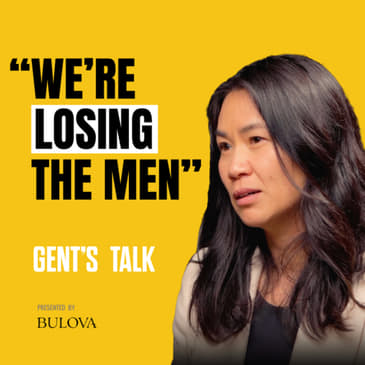
In this week's episode of Gent's Talk, presented by BULOVA, host Samir Mourani sits down with Dr. Ellen Choi, an Assistant Professor at Toronto Metropolitan University, to talk about a new study highlighting the positive impacts of a contemporary men's group and the effects that has on men versus traditional therapy. Dr. Choi talks about the role of psychedelic therapy as a growing practice and questions why we keep losing men to their mental illnesses. #gentstalk Connect with us! Subscribe here ► https://www.youtube.com/@GentsTalkPodcast Website: https://gentspost.com/ Instagram: https://www.instagram.com/gentspost/ TikTok: https://www.tiktok.com/@gentstalkpod Facebook: https://www.facebook.com/gentspost/ About Gent's Talk: The Gent's Talk series, powered by Gent's Post and presented by BULOVA Canada is an episodic video podcast conversation with leading gents and rising stars across various industries. Guests include Russell Peters, James Blunt, Robin Sharma, Director X, JP Saxe, Wes Hall, Johnny Orlando, Shan Boodram, Dom Gabriel, and Nick Bateman, just to name a few. The conversations range from career path, hurtles, mental health, family, relationships, business, and everything in between. Gent's Talk is the first-ever video podcast to be made available for streaming on all Air Canada domestic/international flights. We aim to have a raw, unfiltered conversations about our guests' lives, how they achieved success, lessons learned along the way, and the challenges encountered. Credits: Host/Producer: Samir Mourani Creative Director and Executive Producer: Steven Branco Video & Sound Editor: Roman Lapshin A STAMINA Group Production, powered by Gent's Post.
The Gent's Talk podcast, hosted by Samir Mourani, pulls the curtain back on difficult conversations around mental health, business, relationships and the difficulties around expressing oneself, with rising and leading gents from across the globe.
New episodes every Monday! #GentsTalk
Instagram: https://instagram.com/gentstalkpod
TikTok: https://tiktok.com/gentstalkpod
YouTube: https://www.youtube.com/@GentsTalkPodcast
[00:00:00] It doesn't make sense. We have access to so many resources, not everyone, but many of us have access to like the basic resources that allow us just to live.
[00:00:16] And yet how can so many people be getting to the point where they feel like suicide is the only choice that they have left? And not even so many people like the statistics around men and suicide are just heartbreaking.
[00:00:33] Yeah, it's interesting to see the number of different industries where mental health just weaves itself through all of those industries. And you almost think that there's going to be a difference in the way it applies to every industry. But there's similarities across the board.
[00:01:09] Burnout, work-life balance, the stigmas of saying to your employer, your boss, hey, I'm not doing okay. And how does that affect your ability to get a promotion? Does that put you in a little corner where suddenly people think you're not capable of doing your job?
[00:01:24] Can you be high performing and still have a mental illness of some kind? Can you even talk about these things openly? Right. So seeing a lot of those conversations has been extremely interesting.
[00:01:35] But before we go any further down that rabbit hole, Dr. Ellen Joy, welcome to the Gents Talk podcast. Thank you for coming. It's my pleasure to be here. You are doing amazing work. You're an assistant professor at the university. Sorry, TMU, Toronto Metropolitan University.
[00:01:54] I keep wanting to call it Ryerson University, but that's what it was previously known as. And you released a can we call it a study? Yeah. Would that be the right term? So I have the title here because I don't want to get it wrong.
[00:02:07] It's called I could just exist, not in a box, experiential examinations of masculinity within a contemporary men's group. Can we start by just talking about what that means? We sure can. It's a very long title.
[00:02:25] We called it that because that's a direct quote from one of the participants. So a contemporary men's group is when a group of male peers come together, there can be an expert facilitator, sometimes not. But you explore more intimate topics and you discuss them in groups together.
[00:02:49] That's a contemporary men's group. And one of the quotes came from this man that was saying there's such a clear cut ideal of what it means to be a man and what masculinity represents.
[00:03:02] And for him, the more work he did in this group, he started to realize like that doesn't fit me anymore. There's this box. And if we could just smash it open, we could, in fact, just be human.
[00:03:15] And that resonated so much because what we were looking at was these conceptualizations of masculinity. They're socially constructed, so they're created based on the norms of the people and the interactions around us and over time. And to create new ones, you have to create that in group.
[00:03:44] Does that make sense? Why is the group part so important? The group part is so important because how you come to know what it means to be a man occurs through sense making of the collective.
[00:04:01] And something really interesting about men in particular is something from the precarious manhood studies where men more than womanhood, manhood is constantly being negotiated and renegotiated. So you're looking around you and you feel like you have to perform or prove your manliness ongoing, continuously over time.
[00:04:31] And that's tiring. Whereas women don't? Whereas women don't. Interesting. We don't have the same fluctuation or pressure or need prior to this profession. I used to work in commercial real estate, which is predominantly male, predominantly white male. That's another thing.
[00:04:50] They would always say you're only as good as your last deal. You're only as good as your last deal. So you'd always be hustling to close your next deal.
[00:04:58] And I think with masculinity, that's a really interesting concept because you are constantly having to prove how manly you are and what manly rights are. And what manly represents to you, if it's rooted in traditional hegemonic descriptions of manliness.
[00:05:22] And what I mean by that is like you're really tough or you're stoic or you don't ask for help because these would threaten what it means for you to be a man. Which is a weakness. Yeah. Which is just human. Right.
[00:05:37] But if you're emotional, then you're a sissy. You know the whole boys don't cry. There are so many examples of what this looks like.
[00:05:45] But if that's what you think it means to be a man, then on the back end of that when we look at mental health outcomes or help seeking behaviors, of course you're going to seek less help because your whole identity would be threatened.
[00:06:03] And humans, we protect our identity incredibly closely. Yeah. Why was a study like this needed? Why did you feel that this was a time where this needed to take place? It's a beautiful question. My original research interests are in mindfulness.
[00:06:24] So how present moment, present moment non-judgmental attention can help us be more here for the lives that we're living. But in those studies, it was predominantly middle aged women, middle aged white women that were participating.
[00:06:45] And I think you could say generally when you look at how wellness interventions are studied that that population is the most representative of what we know of well-being interventions currently. I think that's like reasonably fair to say. And my question kept being like, where are the men?
[00:07:06] Why aren't men coming into these studies? And then even now I'm working on a project with CMHA Ontario. So Canadian Mental Health Association Ontario, and they've created free programming for organizations and it's beautiful programming and it's free. So the barrier sentry should be low.
[00:07:27] And then when we looked at who actually participates or at least two completed the surveys again, it's the same. It's predominantly women. But everybody is suffering. Everybody is human. We all have ups and downs.
[00:07:43] COVID I think cracked open a lot of the human experience that if we didn't have so much pressure to meet in those moments, we could easily have just kept coasting. But for many people, the pressure squeezed something. And now what do you do with that something?
[00:08:05] And if you're a woman, you just have permission to explore your emotions or you have social containers and relationships that are deep and intimate and vulnerable. But the male experience is really different. And it's ironic, actually, because in corporate settings, for example, men can speak much more freely.
[00:08:36] They can speak quieter and be heard louder than women. And I think empirically, this is supported. But then when I look at many men in the relationships, maybe with their romantic partner or with their friendships, the emotional intimacy is just virtually nil.
[00:08:56] There's so much that they're not saying out loud. There's so much of their own needs they're not attuned to or advocating for.
[00:09:04] I think part of that is because there's this masculine expectation of being a provider or their supporter or the one that has it together, the emotional rock.
[00:09:17] And if we're not going to start challenging those expectations, then how can men start to do the work and the healing that's so necessary?
[00:09:38] And maybe this is like too much of a tangent, but given the amount of power that men sort of inherently have in the society we live in, I think there's something really exciting about healing and giving men more permission to explore this whole side of them that exists,
[00:09:59] but that they're suppressing in a healthy way so that, I mean, I'm seeing the word flow on our table here. But that both aspects of the rational and emotional can flow more organically in men and then also in women. Can we maybe then start take a step backwards?
[00:10:25] How is this developing in men? How is this current approach to masculinity, this current approach to not expressing emotions and vulnerability?
[00:10:37] I mean we all talk about it thinking, oh well it starts when they're young, probably their dads didn't show us like our dads didn't show us the emotions or the affection and we didn't really get taught how to do it.
[00:10:46] And I've also heard people say that's an excuse. I'm curious from where you're sitting and what you've seen in your studies, how is it actually starting in men?
[00:10:57] At what age is it most dominantly affecting and changing the psyche of how a man approaches his emotions and how he approaches the world and when he's to your point, when he begins renegotiating what it means to be a man daily.
[00:11:12] Okay, I'm going to keep it really close to the research I did because there would be many different perspectives and answers to this. But in our paper our position is that masculinity is incredibly socially driven.
[00:11:26] So you're learning what it means to be a man, you're ascribing all of that meaning from the moment you start perceiving these relationships and expectations. So you're a child, it's being role modeled for you, you're noticing it in how men interact with men.
[00:11:43] When people step outside of their gender role expectations and they behave counter to what's normative, it's called gender role strain. And it gets shut down really quickly. So you would become like a social pariah.
[00:12:02] You get ostracized, you get made fun of, you get cut down and that you'll feel very quickly. You could watch men talk and there's always like some ribbing that gets exchanged.
[00:12:17] And if someone is too soft or too emotional or too sensitive, the social group gives you those cues that that's happening. Does that make sense? Depending on what social group you're part of, different norms will emerge.
[00:12:38] So if you are gifted the presence of a very self-aware, socially aware father that's emotionally intelligent, like I'm picturing someone that's self-compassionate, high self-efficacy, intrinsically validated. So you don't always have your self-worth evaluated by external measures like the majority of people do.
[00:13:07] If you're gifted the presence of a father like that, then you would have been role modeled and loved in a way that teaches you it's OK to have all your feelings. But I think those are generationally newer ideas.
[00:13:25] I read about those things a lot in positive parenting ideas today, but certainly generationally are new. And it's not even cultural because I'm Korean. My father grew up at the end of the Korean War. So his upbringing would have been very different.
[00:13:45] Not a lot of space for big feelings and the issues that a child might be moving through.
[00:13:52] And we felt that growing up, but I could look to a different culture and you'd have a similar set of expectations and norms because you have like the British stiff upper lip, for example.
[00:14:11] So the amount of emotive permission that's allowed across cultures, I think, has always been erring towards suppression and repression. And now is changing. So this is a long winded answer, maybe.
[00:14:29] But in short, what it means to be a man gets taught to us from the people that raise us and the friends that we make and the relationships that we witness. And once attitudes are formed, it is, in fact, pretty difficult to change them.
[00:14:52] It takes a lot of conscious effort. And particularly in our paper, what we found is like something has to happen to you that makes you seriously question whether masculinity as it stands is working for you.
[00:15:07] Like most of the men that by the time they come to these groups, they've done one on one therapy. They've struggled with addiction. They've gone through a divorce or multiple divorces. They've lost their career.
[00:15:24] So they wait until basically something crashes and burns and then it's a rock bottom to help scenario. Yeah. And that was me. I know we when you and I had a conversation before we started recording. We've talked about that as well. That was my personal experience.
[00:15:40] I waited until rock bottom before I said this version is not working for me and I need to recalibrate my entire identity against what masculinity is. And that even then, I was still unsure. How do I even articulate the words?
[00:15:53] I need help. How do I even say to someone I'm feeling all of these emotions that I don't know how to categorize? I don't know how to explain them, but they make me feel very nervous, very anxious all the time.
[00:16:06] And I don't know what to do with them. Even that process, even admitting to myself that that was a thing was part of the challenge of it all.
[00:16:15] And I grew up with a father who was extremely loving, but he grew up without a father. He grew up in a civil war. So he didn't necessarily have the tools and resources to learn how to be the type of father that you talked about.
[00:16:31] So I waited until that moment before I said, OK, I need to do something about this. And to your point, a lot of men are doing that too. How do we get more proactive about it?
[00:16:43] Because as you were talking, I was thinking to myself, if I've had conversations with people who would listen to something like this, watch something like this and go,
[00:16:51] I'm not being one of those new Western men who are just always in touch with their feelings and you're either too feminine or too woke. I'm not dealing with this nonsense. I'm just not interested in this. A man is strong. A man provides he doesn't cry.
[00:17:06] He doesn't show emotions. He doesn't. If you I've had comments like if you say any of these things to your to your woman, I'm quoting this.
[00:17:14] If you say any of these any of these things to your woman, they won't be with you anymore. They'll look down on you. They'll manipulate you. They'll use you if you're this week with other men, they will take advantage of you.
[00:17:24] Nice guys finish last. If we're approaching all of this being where I'm at and now I'm on a bit of a tangent being where I'm at, I see the value of it all.
[00:17:36] I understand it completely. I wholeheartedly stand by it. And I'm unashamed when I talk about it. I'm not nervous about it. I'm not fearful of being judged about it because I also know to get to where I'm at takes a lot of work.
[00:17:50] And secondly, I'm very, very comfortable in my skin now. But for the men who are still holding on so tightly and risk waiting until they hit rock bottom, how do you how do you get to them?
[00:18:12] That is such a complicated question. The way that our system and society and meaning making currently exists, it's very hard for men to seek help before they hit rock bottom.
[00:18:25] There are so many barriers in place that make you gaslight yourself and tell yourself like, that's it's not such a big deal.
[00:18:34] Like, why are you being such a P word? The thing that makes people change is that they realize like this feels so yucky. I can't keep doing this. So something has to be bad enough. Hopefully it doesn't need to be so bad that you lose everything.
[00:18:58] But that requires some willingness to be introspective, self aware, attuned to your needs. There's just so many people walking around not attuned to their needs. It's like you wait until you're about to pee your pants until you actually get up and go to the bathroom.
[00:19:16] Most of us live in this tightrope. And if I steal words from Glendon Doyle, that's like you're either killing yourself. It looks like you're killing it or you're dying.
[00:19:28] It's like this very thin line because you're juggling all the things all the time. Like that's the world that we live in.
[00:19:35] I would say if you are at all starting to feel like, is this it? Like, what is the point? Or maybe you feel like you were saying like, I don't know what I'm feeling, but I'm angry all the time.
[00:19:53] Or I'm like constantly anxious or I'm like nitpicking every little thing or little things make me explode. Those are warning signs. Those are tiny red flags that should invite you to slow down and say, what's that all about?
[00:20:10] This idea of like, I don't know what I'm feeling. Maybe you just talk about feelings as like valence, like good or bad. If that's where you're at, I think that's a beautiful place to start. Start paying more attention to how you feel.
[00:20:31] Start learning more words that describe your feelings. Alexithymia is the thing where you can't describe what you're feeling when you're feeling it. It occurs a lot in men.
[00:20:45] Once you can become a little bit more emotionally articulate and you can start to notice like I'm feeling calm right now, feeling tired, feeling bored, feeling depressed. That's a beautiful first step because then you are living your life in a way more colorful way.
[00:21:12] Step two is like, can you actually feel the sensations as they're unfolding in your body? So there's this idea of interoception where you can feel your internal body's experience.
[00:21:24] Interoception is super cool because it's like, well, London stockbrokers for instance, those that have higher internal body awareness, they make more money. They last longer in their careers, which is a very sort of traditionally stressful job.
[00:21:45] People make better intuitive decisions when you're connected to your internal experience and most of the emotions you have like one neuroscientist he calls emotions energy in motion because the feelings that you're having are being expressed through your nervous system. So happiness feels like something in your body.
[00:22:06] A couple years ago, my dad had sort of surprise heart surgery and I had this moment of grief where I felt deep in my low belly like two very distinct balls and like to make myself laugh.
[00:22:19] I call myself I call those my dad balls but like I had two balls of grief that were so salient and active physically in my body. And I don't think if I hadn't been practicing these things for so long that I'd be aware of them.
[00:22:35] And I think it's worth mentioning because this idea of like, do I know what I'm feeling is one thing and the second thing is like instead of just thinking about my feelings. Do I have the capacity to feel them?
[00:22:48] To stay with them as they arise and pass away. Can I stay connected to my experience in that way?
[00:22:55] And there is beautiful research that talks about how our attunement to our senses, our access to our sensory experience in any moment is like a shortcut to insight and creativity. And it really quiets the like nattering of our inner critic.
[00:23:13] That's really exciting and it is in fact accessible to us at any moment. So it makes me then question who, if as men, as young men, we're growing up learning from what we're seeing in our interactions with other men.
[00:23:34] It presumes that I guess our parents should be the ones that at least at the very beginning are teaching us what healthy masculinity looks like. But if they're not able to do that because they haven't had great examples of healthy masculinity.
[00:23:51] Then where does who can step into that space? Because it sounds like the current iteration of men, the current generation of men who are waiting for that rock bottom moment. It's almost as if reaction reactive support is the only approach for them.
[00:24:08] You hope that they may become across someone in their life that encourages them and teaches them and shows them through action that it's OK. But for the most part, reactive support.
[00:24:19] But for the next generation of young men who are coming up, you want to almost get to them before they harden that outward shell. Who does that? Yeah, actually beautiful question because a lot of people can carry that influence.
[00:24:35] It can be teachers, coaches, any kind of role model. It could be people they meet in real life or not, which is why something like this set up can be so impactful. It could be them seeing you on a recorded podcast.
[00:24:50] It could be a Tom Brady that says something wise and reveals a part of their vulnerable self. And then they actually get to see that vulnerability be celebrated.
[00:25:02] I mean, all of that fits really nicely into this idea of social cognitive learning where you're basically just watching what people do. If what they do is received well. You mimic it.
[00:25:15] And if what they do is not received well, well, you sure as hell avoid it, which is to sort of cut you off.
[00:25:23] You see that happen often when men express vulnerability, at least on social media, where a lot of kids these days spend the majority of their time when they see a man express himself and then get laughed at or criticized in the comments section.
[00:25:36] You go, I am not putting myself through that landmine. I mean, I had on a guest who talked about how he celebrated for his vulnerability because he has such a big platform. And so his audience, his fans, he's a musician go, wow, that's so inspiring.
[00:25:52] But if one of his fans then turn around and wanted to express that same vulnerability on their social platform without the same following who are loyal, diehard fans, more often than not, he'll be criticized for it and that will shut it down. So how do we.
[00:26:09] It seems like it's all a fine balance of wanting to support, but in practicality, the landmines are so there's so many of them that men are like, I mean, speaking from my own experience, I would see stuff like that and go. Yeah, okay. Great. Great point.
[00:26:29] I'd like to introduce the idea of a safe container into this conversation. Okay. In the men's group, people would talk about I will share to this depth here in this circle of trust.
[00:26:43] But I'm not ready to take this kind of intimacy and take it out to my to the other guys at work or to my other friends yet or to my son-in-law for that matter.
[00:26:55] It would take quite a bit of practice and courage to allow their weaker, more vulnerable, less manly parts of themselves to show up in that safe container for them to give those parts voice to allow those parts be received.
[00:27:22] And with enough reps, either of their own experience or even watching other people do it, which is kind of the beauty of group work is that you don't have to do all the heavy lifting. You can get so much benefit just by seeing other people do the work.
[00:27:35] You learn the same things. And when you have enough reps of this pattern where you do the scary thing and it goes well, and you're received with connection and belonging, what it does is enables authenticity. You had said earlier, I'm comfortable enough in my own skin.
[00:27:57] So now I did it. Something happened for you where either the situation was dire enough that you were forced to and then you survived. So you met yourself and you came to know and respect and love that part of you.
[00:28:11] So now that's just you're just moving through the world like that. That's the beauty of the safe container. If you're just on social media and you're throwing this in the comments and the trolling is like breaking your heart open. And that would be a very human response.
[00:28:29] It just means that maybe you need more work in a safe container before you're bringing that outward. And frankly, it's really delicate because what I think would be so sad is that someone hears this message and is like, OK, I'm going to go out into the world.
[00:28:46] And I'm going to take my tender heart. And like there is a balance between the work that we're doing, the tenderness and the sacredness of this inner work and the reality of the society that we live in. Like not everyone is woke yet.
[00:29:06] And there are certainly people that are too woke. And I think even with men's work, there's a risk of it becoming like solipsism, like just a self-obsessed, self-pitying. Like I've seen groups like that too. Interesting.
[00:29:25] So I think there's a way to do this work where you are empowered to like call back those broken parts of you that are like weak and suffering that normally were like, you're a loser. Get out of here and like be like, oh, you're a loser.
[00:29:42] You lost today. And that's hard. And like I see that and that sucks. And you didn't want that to happen. And it's like it's OK for that to happen. We're going to learn from it and move on. I want to actually jump on that point there.
[00:29:56] Whenever I've come across these types of conversations around you had a loss today and instead of going, you know, man up and deal with it, let's embrace the fact that you felt a loss. Go through those emotions. It's OK to express them.
[00:30:16] It's OK to let them out and everything. The argument against that is now you're creating a generation of soft men. And I wonder if that's just poor language.
[00:30:26] And what people are really trying to say is you're reducing the resiliency amongst these men, the ability to actually handle tough situations and move past them to become a better version of yourself.
[00:30:38] Where if you took that loss and everybody coddled you, then you're going to feel like, oh, it doesn't matter if I take another loss. Everyone's just going to coddle me anyway. And now you're not actually trying to do more thoughts on that. No, man.
[00:30:54] I mean, if we slow down that response and examine the words that we use. Is empathy and validation the same as coddling? What I hear in that description is like all or nothing thinking. It's very black and white.
[00:31:17] I think the West is very like we love things in containers. On continuums of opposites and in Easter traditions, like everything's very pluralistic. It's all happening at once. You can be happy and sad. You can be successful and broken like life is just flowy. It just is.
[00:31:46] And OK, let me take it to errors in hospital settings when people in hospital settings make errors. You really want people to report them. You don't want them to hide them because people can die even like a typo can lead to an overdose.
[00:32:07] So you really need errors in hospitals to be something that gets managed adaptively. And yet errors get hidden all the time. In a study done, gosh, almost like 10 years ago, we looked at what helps people actually not hide their errors.
[00:32:27] And what we see is this moment, this inflection point of self-compassion enables authenticity. It enables like the. I am who I am. Flaws and all like I can report this because it doesn't define me.
[00:32:43] But people don't get there without this, that like cushion of like, it's OK for me to be human. I think that this idea of conflating. Oh, that was a hard moment. Failure is hard and you didn't want that to happen. And I get that.
[00:33:05] That can, in fact, exist alongside. Like and we're going to get up and that was tricky and it's hard. It's not the end of the story. There is another chapter here. So for those people that think like, oh, we're raising just a generation of softies.
[00:33:28] I would say maybe that's true. Are you taking away the necessity to move through the full stress cycle? In which case, yeah, you can't just clear the path and never ask people to move through it. I'm not advocating for that.
[00:33:44] What I'm saying is you can acknowledge things that are hard when they're hard. You can say like, what are your thoughts around that? Are you noticing any feelings? Do you feel anything in your body? Tension there. Yeah. OK, let's just stay there for a moment.
[00:34:02] Take a bigger breath. I'm really into the physiological side these days because it's like so effective, so fast. So double inhale, double sip of in-breath and then audible exhale. And I love doing that with my kids.
[00:34:21] It like biohacks them so quickly to get them to a state where they're way more present. And I didn't take away their discomfort and we just kept moving through. I think that's really important. The idea of men's groups.
[00:34:44] Firstly, I think men in general, myself included, for a long time struggled with this idea of talking to another person. Yeah. I had always subscribed to this idea that therapy was for crazy people. That crazy uncle or aunt was the only person that went to therapy. I'm good.
[00:35:05] And then at different points, you would talk to some people who would be like your therapy is between you and God or some religious entity, which can be a one sided conversation. So it ends up just being self-talk.
[00:35:19] And we I'm sure we both can talk for hours about how self-talk can be harmful by itself. So the idea of going into another group with multiple other men and sharing your experience takes a certain amount of courage just to even get into the room.
[00:35:40] What are you seeing happening in men's groups that's so powerful enough that it's actually working? And how does that perhaps take away from the argument, if at all, that one on one therapy may not be as effective? Yeah. OK.
[00:36:03] One on one therapy challenges head on a lot of norms related to men and masculinity that it makes sense to me that it's very threatening. And. Maybe less efficacious in some like population to population that makes sense to me.
[00:36:28] It requires like an amount of self awareness and self disclosure that like takes a long time to get to. I would say psychedelics is a really nice pairing with that because it would just cut through like a hot butter knife.
[00:36:46] A lot of our own self protective layers that would be very helpful. That's one on one therapy. There's a growing amount of that. I've been seeing more and more coverage around psychedelic assisted therapy. Yeah, I know it's fascinating.
[00:37:02] I think the the wave of research and why it began and ended is has like a really political story behind it. And I just like to look at outcomes like, is it working? Great. Does it work for many people? Yes. Excellent. Let's keep studying it.
[00:37:21] So that psychedelics with groups. One thing that I think the contemporary groups are doing really well is that one word of mouth goes a long way to like just straight up marketing. When you see who's going to these groups, you can see yourself in them. The other guys.
[00:37:46] Yeah, you see like other guys that kind of look like you or that like you might aspire to be with the men that I was interviewing. I think one of the coolest guys was like an ex DEA agent. He's like super ripped.
[00:38:00] He's got tats up and down his arm. He's he was like just an interesting dude that you would love to speak to period. But then he talks like he is Brene Brown. And then you're like, whoa, this is incredible.
[00:38:13] And for those who don't know what a DEA agent that's a drug enforcement agent. That's right. Yeah. He was like an undercover DEA agent. He was fascinating to speak to. The other thing about men's work is that this.
[00:38:27] Like field of therapeutics acknowledges that men come to this work differently and they have different needs because they've been programmed and received messaging for so long that makes traditional therapies a little bit less tenable.
[00:38:44] And one thing that I've seen is like adventure based group work where like you take men into nature, you kind of gamified in some way and it allows you to access through some sort of Trojan horse deeper, more emotional work.
[00:39:01] And you've gained that permission because you've just again taken down the like traditional safeguards or like helped peel off the armor because you said bring your armor and come to this war and we're going to do this thing. And then boom, let's put the armor down now.
[00:39:14] And that's interesting. And I think men's work when presented in a in that kind of way that resonates with broader audiences is very exciting. For the people listening, I would just hope that the questions to ask yourself are like, does this serve me?
[00:39:37] How superficially are you moving through your relationships? If you know that relationships out of all the modalities of well-being are the thing that predict how long you're going to live. And like in the very short time that we're here, what are you here for?
[00:40:00] And if that answer is like, I think I'm leaving some stuff on the table. Then to all of those people, I would say like do the most courageous thing you can and start practicing because it is like a muscle that you strengthen with time.
[00:40:24] What this kind of emotional intimacy can look like. You could test it out with like if you have no one around you, then sign up for a group, even though it's terrifying because you'll be in a container that has the norms that will receive you.
[00:40:40] And this curiosity, if you have people around you, then start with like one friend or like an acquaintance because sometimes it's actually easier to engage in self-disclosure when you don't have such deeply, deeply held rules and expectations, perhaps.
[00:40:58] I think that might be similar to you in your case. It was my breakthrough moment, if you will, was talking to someone who felt a little more like a stranger than like a friend and happened to be an acquaintance that came through an ex-partner.
[00:41:16] So there was already this inherent fear of if I'm a villain in someone's story and this person is related to that someone in some way, are they going to see me as a villain? Will they even pick up the phone?
[00:41:29] And when I called him, I was prepared to talk about anything, the pandemic, anything I could think of before finally just saying, hey, I'm not doing so well.
[00:41:40] But there was something about the way he had spoken at some point in the past that I recalled in that moment and thought he would be a great person to try.
[00:41:49] And when he picked up the phone, which was a surprise to start, he let off by talking about how he was extremely insecure because of the pandemic stripping away his ability to make money.
[00:42:02] And in that moment, I was sitting there going, this is what that vulnerability thing looks like and how I can't judge him. Like, I'd have to be some conniving, evil human being to judge this man as he's conveying his insecurity to me.
[00:42:23] And in some way, that made me feel more comfortable because I thought then he probably feels the same way or would think the same way when I convey my insecurity.
[00:42:34] And then the reason I'm so fascinated by this particular idea or concept of men's groups is because he then introduced me to two other men. And suddenly we have our own little men's group that still exists to this day where we hold each other accountable.
[00:42:51] We share our deepest fears. We talk about these things, but it's also a reminder of look at all these amazing things these men are accomplishing and that having these conversations does not take away from their masculinity.
[00:43:02] They're still doing the best they can. They're still becoming the best versions of themselves, but also going, I'm not OK today. My job is making me insecure. My relationship is faltering my this or that.
[00:43:16] And so I do genuinely believe that having or seeing other men express that emotion is far more and I don't want to use the word superior, but as someone who needs as just generally a visual learner, seeing another man convey that kind of emotion encouraged me to do so.
[00:43:39] So by the time I eventually spoke to a therapist about whatever was troubling me, I was already ready to go into that conversation and I didn't feel like this random stranger is just sitting there getting paid and will judge me after I'm done.
[00:43:54] Yeah, that makes a lot of sense to me. It takes a lot of self awareness. It takes a lot of permission either from the inside out or the outside in to say it's OK to go to this territory.
[00:44:15] And even in that story that you shared there, what I hear is like self shaming, self judgment that keeps people quiet and the oh this is OK because look at what that person just shared and I wouldn't judge that.
[00:44:33] What that reveals is how much of our own experience we're like.
[00:44:39] Judging as XYZ that then prevents us from expressing and experiencing frankly, and we are so obsessed with being awesome like the ascent let's climb and conquer and drive and succeed and and like I get that overachievement is also one of my love languages.
[00:45:03] Like I'm on board and I am increasingly aware of how limiting that is because we become very attached to life as like happiness and successful. And when it's not those things, it feels like failure.
[00:45:20] And what if life is actually just this constant braiding of all these experiences, but we're missing so much of it because we think it just looks like the one hair of winning. And I'm watching people in my own very privileged community deal with suicide.
[00:45:42] And like I know the S word touches close to your heart and your work too. It doesn't make sense. We have access to so many resources, not everyone, but many of us have access to like the basic resources that allow us just to live.
[00:46:07] And yet how can so many people be getting to the point where they feel like suicide is the only choice that they have left and not even so many people like the statistics around men and suicide are just heartbreaking.
[00:46:22] And my wish for men and inevitably the people around them because it's a trickle over effect.
[00:46:34] Of course, what happens inside touches everyone around you is that you slow down and permit yourself to attune to what's happening inside you and like not even the most important thing that you can do is to just let go. Not experience it as good or bad.
[00:46:58] Okay, not okay. Manly, wimpy, whatever. But just explore it a little bit more with, I don't know, some curiosity maybe.
[00:47:09] And whether or not you have like the bestest loving father or like a coach or a role model or a great friend, maybe you don't have any of those. But maybe you can just start to show up for yourself in a way that's more present and less judgy.
[00:47:29] And that kind of self compassionate relationship has been found to meet like the basic psychological needs of belongingness. Like you can meet those needs actually for yourself.
[00:47:43] And that is also a whole very empowered way to heal if you really don't have access to a world around you that's safe. What's the role of women in all this? I'm talking obviously specifically from a straight relationship perspective.
[00:48:02] And I imagine there's also variations when you're looking at gay men versus straight men. But something I personally feel isn't talked about enough is toxic femininity and the role that that plays sometimes in shaping the narrative around modern masculinity. Yeah. The way we respond to these things.
[00:48:21] When you look at, again, and I'm talking about this from the lens of social media because that's where we spend so much of our time on these days.
[00:48:29] And you look at some of the comment sections or you look at some of the influencers and thought leaders out there who are making these very broad sweeping statements around,
[00:48:41] you know, if the man doesn't drive this type of car, making this amount of money who can provide me this amount of five course meals a week type of thing. I'm not interested. And of course, those are the videos that go viral.
[00:48:55] And those are the videos that show up in your impressionable young man's feed and then shapes the way he sees dating the way he sees relationships.
[00:49:06] And so if he's not making six figures a year by the age he's 22, if he's not an entrepreneur with seven side hustles and driving a Lamborghini, he somehow failed. What's the role of women in all this? I know it's a loaded question. It's terrifying.
[00:49:21] You're striking fear in my heart. It just goes to show how with every step forward, there is this constant pull and backsliding. OK, so what comes up for me when I hear you say that is the idea of contingent versus optimal self-esteem.
[00:49:42] Everything you're describing their six figure salary drive this car five course meal. That sounds delicious. It's a I feel good about myself if I hit X and that kind of self-worth is incredibly precarious.
[00:49:58] And again, it's really normal because it's like you get this grade and you feel good. Then you get this job and you feel good and you get this relationship and like, oh, look at me in my ring. Yeah. So our lives are set up to hit those markers.
[00:50:12] And that makes sense. And the role of women who have had more permission to explore, to be weak to in many relationships that I see, it's often the women that start first with this kind of healing and self-exploration and then they pull the others along.
[00:50:35] So I would say, you know, I think that's the role of women. And I think that's the role of women who have been working for years along. So I would say that work of learning how to love yourself no matter what,
[00:51:01] to know yourself as like your life force and not just all of your accomplishments. I think when you love others, you show them what's possible. And that can be very compelling as a teacher or a guide or a sense of influence that women could have.
[00:51:33] And even as I say that the like tension between what these gender roles do for men and women, they hold us captive in different ways, but like make no mistake, we are all held captive by them.
[00:51:52] I feel like now more than ever, and I just keep saying this because I feel like it applies to EDI issues. It applies to all of the identity issues that we experience. It's like we have a deep need for affiliation and belonging and connection.
[00:52:17] And those are important to nurture. And we also to be a healthy functioning human that evolves over time, you need to have a sense of individuation away from the group.
[00:52:31] So you begin to experience who you who you really are as a soul, as a spirit, as a as a life force. And when we stick so closely to our social groups, you process information through those same lenses,
[00:52:49] which can be problematic and limiting, whether that's gender or religious beliefs or really anything. If we have no like I'm picturing almost like a scale, like you have to have this sense also of who you really are so that in this lifetime,
[00:53:14] you get to feel that that sense of experience. I think relationally when we just talk about men and we just talk about women, it's very easy to get lost in the gender roles and expectations.
[00:53:31] And so instead of doing that, I think where I would want to leave those two ideas is just to say, could we become more aware of how those gender roles influence our behavior and when they feel constricting to invite ourselves to start to like remember who you are.
[00:54:00] So you can say like, does this does this fit? Is there another way? We're coming up on time here and I feel like you and I can have several more hours of this conversation. So I think it warrants a part two at some point.
[00:54:19] But I think the last thing I want to ask you here is what do you what does this study aim to achieve? What's the goal of it? What are you hoping people take away from it?
[00:54:39] I wanted to show like the men in my own life that where they're at currently is OK. And like the downfall of like good enough and like a little bit better than mediocre is that it doesn't inspire change and necessity.
[00:55:09] But I really wanted to be able to say here is a path. If you're looking for more, this is what works and this is how it works. And the very like simple mechanism is you even if you're not ready,
[00:55:32] you watch someone share something weak that you would have otherwise judged as completely inhospitable material. And instead of them being ostracized, you see them respected and held and you feel in yourself,
[00:55:54] oh shit, like I have all of those same fears and beliefs and I've been carrying that around. I didn't even know I was carrying that around. I didn't even know I was hiding that from myself. And you see instead that person be like loved,
[00:56:11] then I hope that through seeing someone else's like honest pain, that witnessing that connects you to yourself and invites you to live in a way that's like far more open. I think that for all the wives out there married to those men,
[00:56:32] I'm doing them that service and help seeking in terms of like getting help for your mental well-being is such a stretch when so many men I know today still can't ask for help with like an administrative task or directions. This is still very commonplace.
[00:56:52] So the it's a stretch goal, but it's just there is another way it exists. People are doing it. It's incredibly effective and this box that we've stuffed each gender in, it doesn't work. And I think deep down if you feel that constant angst or exhaustion or desperation,
[00:57:19] then you know it doesn't work. And if you know it doesn't work now, then that should be enough that asks you to put in a new program into your computer and run that instead. Thank you so much. You're so welcome. This was super insightful.
[00:57:39] And I really mean it when I say I think this is a conversation I'd love to have a part two with you about because I think that there's so many more threads I want to pull on and just really dive into them.
[00:57:49] I think that this work is incredibly important as someone who's experienced the men's group and the one on one therapy, I can speak to the power of seeing other men be vulnerable,
[00:58:03] pave the way and taught me how to express my vulnerability in a way that didn't take away from my masculinity. I left those conversations still feeling like a strong, confident man. And then also knowing I now know how to be a better version of myself.
[00:58:18] I now know the path to being OK and can still feel the way I feel where I don't feel like I've somehow softened or anything like that. And suddenly I'm comfortable in my own skin and I just grow from there.
[00:58:33] So thank you for the work that you're doing. Please keep doing it. Yeah, ditto. Thank you. And let's have this conversation again. Yeah, I'd love that. Where can people find the study? It is not openly accessible to the public, so it's really hard to get it.
[00:58:54] Unfortunately, the way that academia keeps people out. But if you reach out, I'm at I think Ellen Choi Mind on Instagram. If you message me, I would be happy to send you a link to a free version of the article. Amazing.
[00:59:10] We can can we place one in the episode notes? Yeah, yeah, yeah. Terrific. We'll do that. Thank you so much. Thank you everybody.