
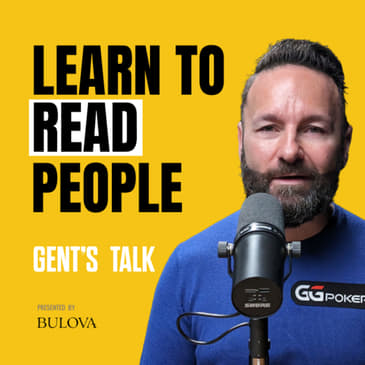
In this week's episode of Gent's Talk, presented by BULOVA, host Samir Mourani sits down with professional poker player Daniel Negreanu to talk about his wild career with earnings in the 7-figure range, the highs and lows, how he copes with stress in high stakes games, the World Series of Poker and his role with GG Poker and the secrets to reading your opponents. #gentstalk Connect with us! Subscribe here ► https://www.youtube.com/@GentsTalkPodcast Website: https://gentspost.com/ Instagram: https://www.instagram.com/gentspost/ TikTok: https://www.tiktok.com/@gentstalkpod Facebook: https://www.facebook.com/gentspost/ About Gent's Talk: The Gent's Talk series, powered by Gent's Post and presented by BULOVA Canada is an episodic video podcast conversation with leading gents and rising stars across various industries. Guests include Russell Peters, James Blunt, Jonathan Osorio, Director X, JP Saxe, Wes Hall, Johnny Orlando, Shan Boodram, Dom Gabriel, and Nick Bateman, just to name a few. The conversations range from career path, hurtles, mental health, family, relationships, business, and everything in between. Gent's Talk is the first-ever video podcast to be made available for streaming on all Air Canada domestic/international flights. We aim to have a raw, unfiltered conversations about our guests' lives, how they achieved success, lessons learned along the way, and the challenges encountered. About Daniel Negreanu: Born and raised in Toronto, Daniel Negreanu won his first WSOP bracelet in 1998 at the age of 23. Since then, he has earned the status of a true Poker Legend, with over $52M+ USD in live poker winnings, six WSOP bracelets and many other championship titles. He has also appeared in multiple music videos, TV shows and movies, including X-Men Origins: Wolverine and Detention. Daniel is active in charitable foundations, having hosted the 2023 Viva St. Jude Charity Series of Poker Event, a charity poker tournament in which Negreanu’s team raised $280,000 for the St. Jude Children’s Research Hospital. Credits: Host/Producer: Samir Mourani Creative Director and Executive Producer: Steven Branco Video & Sound Editor: Roman Lapshin A STAMINA Group Production, powered by Gent's Post.
The Gent's Talk podcast, hosted by Samir Mourani, pulls the curtain back on difficult conversations around mental health, business, relationships and the difficulties around expressing oneself, with rising and leading gents from across the globe.
New episodes every Monday! #GentsTalk
Instagram: https://instagram.com/gentstalkpod
TikTok: https://tiktok.com/gentstalkpod
YouTube: https://www.youtube.com/@GentsTalkPodcast
[00:00:00] So Toby Maguire, I was playing with him in California once.
[00:00:03] We were just playing in a cash game and there was a spot where he bet like actual cash.
[00:00:08] He bet all his money and I started counting out my money, you know, like I was going
[00:00:11] to call him and then he grabbed his cards to turn them over.
[00:00:14] Right?
[00:00:15] So what that tells you is he's excited to show his hand because he's got a very good
[00:00:20] hand.
[00:00:21] Right.
[00:00:22] That's what you would think.
[00:00:23] So he was about and I was no, I didn't call yet.
[00:00:24] I didn't call you.
[00:00:25] Oh, this.
[00:00:26] So I'm like, OK, well, I know I can't beat that.
[00:00:27] So I fold.
[00:00:28] He shows me a complete block.
[00:00:49] Firstly, Daniel, welcome to the Gents Talk pod.
[00:00:51] Yeah, right.
[00:00:52] Yeah.
[00:00:53] Yeah.
[00:00:54] I have been a big fan of yours for a very long time.
[00:00:56] I'm going to admit that right off the top here.
[00:00:58] When I first started watching poker on television, it was you and a few others.
[00:01:03] But your personality was the thing that caught my attention.
[00:01:07] And I was when I found out that you were Canadian, I was like, OK, cool.
[00:01:10] Now I have even more reason to root for you.
[00:01:13] How long have you been playing?
[00:01:14] What was the story there?
[00:01:15] When did you start?
[00:01:17] Let's maybe bring it back for a second.
[00:01:19] Yeah, well, first of all, it's cool to be back in Toronto because this was my stomping
[00:01:22] ground.
[00:01:23] I was born and raised in Toronto.
[00:01:24] I was a Toronto boy.
[00:01:25] I used to read the newspaper and see Bob McCown with his like betting lines and odds.
[00:01:30] And so I got into that sort of life.
[00:01:32] And I just started playing here with friends and things like that.
[00:01:35] And they used to have charity casinos around the city.
[00:01:37] Then I used to go every three days, the Chima Hotel or all these different little
[00:01:42] spots and started to play regularly.
[00:01:43] And I was making like $45 an hour.
[00:01:46] Right.
[00:01:47] And I was in school at the time, but I'm like, hey, you know, I'm doing pretty good.
[00:01:52] The school can wait.
[00:01:53] And so I just, you know, just devoted my time to it and I wanted to be great at
[00:01:57] it.
[00:01:58] And I think like most things in life, if you really, really want to be successful,
[00:02:01] sometimes it requires like sacrifices in other areas.
[00:02:04] You know, so I just eat, breathe sleep poker until I, you know, made some trips
[00:02:08] out to Vegas that did not go well, to say the least for like the first year,
[00:02:13] because I'm a hometown hero guy, right?
[00:02:14] I'm like, I'm going to come in Vegas.
[00:02:16] I'm going to smack these guys around.
[00:02:17] No, no, no.
[00:02:18] They've seen hometown heroes before.
[00:02:20] They, you know, chew them up and spit them out.
[00:02:22] And I was no different at the time.
[00:02:24] So I had a lot of a lot to learn still.
[00:02:26] How did you, I'm curious because, you know, to go in with such ego and pride
[00:02:31] and being like, you know, I'm the shit, I can do this.
[00:02:33] And then getting smacked around as you called it.
[00:02:36] How is that humbling experience?
[00:02:37] It was important.
[00:02:39] You know, I look at it this way, like in life in general, right?
[00:02:43] Moments where you have suffering and pain are the most valuable moments,
[00:02:46] the breakdowns if you will, because they lead to breakthroughs over life.
[00:02:49] You're like, okay, I need to fix this, adjust this.
[00:02:51] And I remember one specific moment, one of the first trips I went there.
[00:02:54] You know, I was playing all night.
[00:02:55] It was like four in the morning.
[00:02:56] I just lost all my money.
[00:02:57] I was playing with seven people, right?
[00:02:58] Went to the bathroom, you know, washed my hands, come out.
[00:03:02] They're all gone.
[00:03:03] They left.
[00:03:04] And I was like, wow, it dawned on me.
[00:03:06] They were only playing because of me.
[00:03:09] I was the sucker.
[00:03:10] And I tell you, I remember every single one of those faces, right?
[00:03:13] Every single one of them, this guy, Hawaiian Bill.
[00:03:15] I couldn't stand him, right?
[00:03:16] After a while, he became sort of a mentor to me.
[00:03:19] Okay.
[00:03:19] So I started to learn that like I came in like a bull in a china shop, right?
[00:03:23] Because in Toronto, that worked.
[00:03:24] I could just pound people.
[00:03:25] Yeah.
[00:03:25] They knew how to pound back and I wasn't accustomed to that.
[00:03:29] So it was a very important learning experience.
[00:03:31] I think like you look at some of the most successful people
[00:03:34] in a lot of different avenues.
[00:03:36] One of the things that's common with them is tons of failure.
[00:03:39] Lots of it.
[00:03:40] Lots of bankruptcies, failures before hitting it big.
[00:03:43] I think that's a pretty common practice.
[00:03:45] It's those people that have learning moments there
[00:03:48] that are able to sort of be resilient and say, okay, well, that didn't work.
[00:03:52] Here's what we're going to adjust and change.
[00:03:53] When you talk about failure and bankruptcy and all those things,
[00:03:56] those are very daunting things.
[00:03:58] And I think for a lot of new players in the poker space
[00:04:01] or when you talk about people who are just trying, they're interested,
[00:04:04] they just want to get into it.
[00:04:06] There's that fear of, oh my God, it's gambling.
[00:04:09] I'm going to lose all my money.
[00:04:10] I don't know what I'm doing.
[00:04:12] But when you also have real conversations with a lot of poker players,
[00:04:17] there's more to it than just blind gambling.
[00:04:19] You're not going to a roulette table at the casino and saying,
[00:04:22] I'm putting my money on this type of thing.
[00:04:25] Maybe can we sort of pull the curtain back on poker as a whole
[00:04:29] and what new players could maybe expect from it?
[00:04:32] Well, you bring up a good point with the sort of roulette stuff
[00:04:35] because when you play roulette, who's your opponent?
[00:04:37] The casino.
[00:04:38] They don't lose.
[00:04:40] Come on, they don't lose.
[00:04:41] Now poker is different.
[00:04:42] If you and me, we play poker at the casino.
[00:04:44] I'm not playing against casino.
[00:04:45] I play against you.
[00:04:47] They charge me rent for the seat.
[00:04:49] So I got to pay whatever I pay,
[00:04:51] but it's my wit against your wit.
[00:04:53] And they don't really care who wins.
[00:04:54] So this is an environment where you can actually win.
[00:04:56] And when you talk about gambling as a whole,
[00:04:58] everyone sees, oh, you're just gambling.
[00:05:00] What do you think the stock market is?
[00:05:02] You invest money in some.
[00:05:04] What do you think when you open a restaurant,
[00:05:06] what exactly are you doing here?
[00:05:08] You are putting a lot of money into something, right?
[00:05:10] Gambling on the hope that your food
[00:05:13] is gonna be value enough to people
[00:05:14] and people will come and eat it.
[00:05:15] What happens if they don't?
[00:05:16] Well, guess what?
[00:05:17] You lose all your money.
[00:05:18] So when you get married, right?
[00:05:21] You're taking a risk.
[00:05:22] This is gonna work out fine
[00:05:23] and half your money's still gonna be there by the end.
[00:05:26] Literally, you can look at almost every profession
[00:05:29] and realize there's risk at some point
[00:05:30] and that's gambling.
[00:05:31] With poker, it sort of has that connotation
[00:05:33] because it's straight gambling, if you will.
[00:05:36] But again, look at stock market, right?
[00:05:38] The people that are professionals at it,
[00:05:39] they lose sometimes.
[00:05:41] They don't always win,
[00:05:42] but they have an edge because they're sharper
[00:05:45] and that's what poker players, the pros do.
[00:05:47] They're just a little bit more,
[00:05:50] they have a better understanding of spots.
[00:05:52] Well, can you maybe help me understand
[00:05:55] or help us understand,
[00:05:57] what is that difference between a good player and a pro?
[00:06:02] What is it that a pro does
[00:06:04] that separates them from the rest?
[00:06:06] Okay, so one of the things you need
[00:06:08] to sort of have in your repertoire,
[00:06:09] if you're a pro, is some discipline.
[00:06:11] Like I remember growing up,
[00:06:12] a lot of guys were talented.
[00:06:14] They had some skill sets,
[00:06:15] but they didn't have the emotional stability
[00:06:17] to deal with the swings.
[00:06:18] So when they were winning and doing well,
[00:06:20] they were fine.
[00:06:21] When things went badly,
[00:06:23] they didn't play their same game.
[00:06:24] We call that tilt.
[00:06:25] That's the term for it, like a pinball machine.
[00:06:27] You're on tilt and now you start playing
[00:06:29] like an idiot yourself
[00:06:30] and then you just start dumping the money.
[00:06:31] So discipline is really, really important.
[00:06:34] In terms of like elevating to that next place
[00:06:37] where like, okay, I need to make a living here doing this
[00:06:41] so I can't be all reckless.
[00:06:43] Sure.
[00:06:43] So is there a moment that you can draw back to
[00:06:47] where you were tilted
[00:06:49] and things just went completely south for you?
[00:06:51] Many times.
[00:06:52] Yeah, tilt is something you're gonna experience
[00:06:54] when you play poker, right?
[00:06:55] Like you can say,
[00:06:57] you can think all you want about your like,
[00:06:58] oh, I'm home by y'all,
[00:07:00] I'm boom, boom.
[00:07:02] But no, you know, you get pissed off, you get upset.
[00:07:03] Sometimes you think like,
[00:07:05] you know, the cards are spitting in your face.
[00:07:06] You're like, how could I possibly lose this?
[00:07:08] Like every poker player who's played,
[00:07:10] like a lot of them think they're the unluckiest person
[00:07:12] in the world.
[00:07:13] Like you're not, okay?
[00:07:14] But everyone goes through it, even me.
[00:07:16] Like honestly, year ago and the year before,
[00:07:18] I had a horrible year
[00:07:19] and I've been doing this 30 years.
[00:07:20] And I just was like,
[00:07:21] no matter what I did,
[00:07:22] the cards wouldn't cooperate.
[00:07:23] That's probably the frustrating thing about poker for people
[00:07:26] is you can do everything right,
[00:07:27] make all the right decisions
[00:07:29] and still lose money.
[00:07:31] And I think that's the biggest misnomer that people have
[00:07:33] is that you can,
[00:07:36] obviously whenever you watch poker,
[00:07:38] whenever you watch the social posts
[00:07:39] of a poker tournament or whatnot,
[00:07:42] they glorify the moments where someone bluffs
[00:07:45] with nothing in their hand type of thing.
[00:07:47] But in reality, it's a lot harder
[00:07:49] than what you're seeing in those very small moments
[00:07:52] over the course of several hours
[00:07:53] of playing in a tournament.
[00:07:55] Which is also a thing in and of itself.
[00:07:56] Like you go through a lot of stress
[00:07:59] sitting there for eight, nine hours
[00:08:01] playing through a tournament
[00:08:02] over multiple days type of thing.
[00:08:03] Like you're playing in one right now
[00:08:05] at the World Series of Poker in Toronto.
[00:08:07] And just what are you seeing
[00:08:09] from sort of people sitting in there
[00:08:12] playing in a group setting?
[00:08:14] Is there a level of intimidation for players?
[00:08:16] Do you see a lot of new players playing?
[00:08:18] Is it just poker pros?
[00:08:20] Well here in Toronto,
[00:08:22] so we had for the first time ever
[00:08:23] at the Great Canadian in Toronto here,
[00:08:26] the new casino.
[00:08:28] It's like the first time
[00:08:28] there's ever been anything like this.
[00:08:30] So what you're gonna see,
[00:08:31] you're gonna see a lot of new faces, right?
[00:08:33] A lot of people that are somewhat amateurish, right?
[00:08:36] So when I sit down at the table,
[00:08:37] they're typically pretty shocked to see me there.
[00:08:40] That's Daniel McGrath.
[00:08:41] Yeah, there's intimidation because I'm me, right?
[00:08:44] And they know who I am.
[00:08:45] So I have a little bit of an advantage
[00:08:48] in that regard there.
[00:08:48] But there's some pros, there's some local pros.
[00:08:51] I see some guys that make trips out to Las Vegas
[00:08:53] and stuff like that.
[00:08:54] And I'd like to see more come.
[00:08:55] Part of what we're doing,
[00:08:57] at GG Poker is we have this thing called
[00:08:59] the Road to Vegas,
[00:09:00] which is you can play online.
[00:09:02] You can win your seat,
[00:09:03] you can win your way to Las Vegas
[00:09:05] to play in the main event.
[00:09:06] So that's part of what I was here doing,
[00:09:07] promoting more Canadians to come out
[00:09:10] and play the World Series of Poker this year.
[00:09:12] Is there a limitation or is there a smaller number
[00:09:17] of Canadians playing compared
[00:09:19] to other nationalities right now?
[00:09:21] Actually Canada represents a big percentage.
[00:09:23] Like last year on GG Poker, right?
[00:09:25] Which, well on the late site.
[00:09:27] They dealt like 3.8 million hands.
[00:09:29] Three billion in prize money was given away
[00:09:31] or something crazy like that.
[00:09:33] And a big percentage of that
[00:09:34] actually is Canadian players.
[00:09:35] Ontario's a little different
[00:09:38] because of the regulation where in Ontario,
[00:09:40] people can only play against each other.
[00:09:43] Where there's an international site
[00:09:44] where people play with people from France and Italy
[00:09:46] or wherever else.
[00:09:48] So hopefully, I don't have anything to do with the laws,
[00:09:51] but hopefully they open it up.
[00:09:52] Because it's better for the players.
[00:09:53] You want to have those huge prize pools.
[00:09:57] And players in Ontario, unfortunately,
[00:09:59] they can only play on the Ontario site.
[00:10:01] Interesting that that would be a rule.
[00:10:04] A few countries have tried it and it's really silly.
[00:10:06] I don't know why they do it.
[00:10:07] They're short-sighted.
[00:10:08] I can't think of why it would be beneficial.
[00:10:10] Like I can't think of the pro argument for it.
[00:10:12] I think they probably feel like they have more control
[00:10:14] over what's happening when it's all based
[00:10:16] solely in their region, right?
[00:10:18] I see.
[00:10:19] I don't know.
[00:10:20] I mean again, I'm not a lawyer or anything like that.
[00:10:22] But it is better for players
[00:10:24] when you can have the liquidity of like the entire world.
[00:10:27] Sure, more chances at winning.
[00:10:29] Just bigger, yeah, bigger prize pools.
[00:10:32] How do you overcome the losses?
[00:10:35] I'm sure at this point in your career,
[00:10:37] and perhaps I'm wrong here,
[00:10:39] but you've sort of established a way
[00:10:40] where you deal with the loss and you go,
[00:10:42] like last year you said you had a really bad year
[00:10:44] and you go, okay, it happened.
[00:10:47] I'm capable of moving forward.
[00:10:48] But early on in your career,
[00:10:50] I'm sure you took those losses quite hard, right?
[00:10:53] How do you overcome those?
[00:10:55] Because it's one thing when you're trying to do something
[00:10:58] and it doesn't work.
[00:10:59] It's another when you're trying to do something
[00:11:00] and it doesn't work,
[00:11:01] and you've lost money in the process.
[00:11:02] Like that's a very daunting feeling for a lot of people.
[00:11:05] Well, I think one of the most important aspects
[00:11:07] of what's kept me successful all these years
[00:11:08] is resilience.
[00:11:10] Is the ability to like have those down moments
[00:11:12] and then allow myself to vent,
[00:11:15] to sulk if you will for a moment.
[00:11:17] But then I wake up that next morning hungry
[00:11:19] and ready to go do it all over again, right?
[00:11:20] So I think one of the biggest mistakes people make
[00:11:24] in poker and life in general is like hold things in
[00:11:26] and don't actually experience the experience, right?
[00:11:28] I allow myself to vent.
[00:11:30] I want it out.
[00:11:31] I wanna just like, this is brutal.
[00:11:32] I can't believe this.
[00:11:34] I'll be a victim to circumstance if you will.
[00:11:36] But once I'm past that, now I allow myself to go,
[00:11:40] okay, well, you know what?
[00:11:41] What are we gonna do about it?
[00:11:42] We're gonna show up,
[00:11:43] we're gonna wake up the next morning
[00:11:44] and we're gonna go right back in there.
[00:11:46] And again, for a lot of people,
[00:11:48] it's not for everybody.
[00:11:49] A lot of people cannot handle the stress and the pain
[00:11:51] of losing all the time.
[00:11:54] Like you can go through stretches where let's say
[00:11:54] I have a pair of aces and you have a pair of sixes, right?
[00:11:57] The math says I'm gonna win about 80% of the time, right?
[00:12:01] One out of five times, even though I did everything right,
[00:12:03] you're gonna beat me.
[00:12:04] And sometimes that one out of five times
[00:12:06] happens three, four times in a row
[00:12:07] and you start going, this is impossible, right?
[00:12:10] And that's the hard part, I think for people playing.
[00:12:12] But it's also the fun part.
[00:12:13] You know, like it's also where the enjoyment
[00:12:16] comes from in a way.
[00:12:17] It's like the thrill of victory and the agony of defeat.
[00:12:20] You don't have one without the other.
[00:12:22] It's interesting you talk about the math part.
[00:12:25] That's something that's always been interesting to me.
[00:12:26] I play poker semi-regularly.
[00:12:29] I don't quite have the math part down.
[00:12:31] How does that process even work?
[00:12:33] Like how do you even acquire the skillset
[00:12:34] when you're playing with percentages and whatnot?
[00:12:37] Because there's moments where I'm watching pro players
[00:12:39] play and something happens and they're sitting,
[00:12:42] they're thinking, and then you can tell
[00:12:43] that they're basically doing some sort of calculation
[00:12:45] in their head.
[00:12:46] And a lot of people have asked me,
[00:12:48] because I posted that you were coming onto the podcast,
[00:12:52] how does the math element work?
[00:12:54] Can you maybe share a little bit there?
[00:12:55] Sure, yeah.
[00:12:56] So like I'm gonna separate this two different ways.
[00:12:59] If you're a casual player that just wants to like
[00:13:01] enjoy yourself and learn a little bit,
[00:13:03] then you don't have to bog down too much with the math.
[00:13:06] Like you need to know the basic math,
[00:13:07] which is what we used way back when.
[00:13:09] Doyle Brunson many years ago,
[00:13:10] before there were computers or anything,
[00:13:12] he would literally deal the cards out
[00:13:13] and keep track with a pen and paper and say,
[00:13:15] okay, ace king against the pair of fours
[00:13:17] and he would win 53% of the time.
[00:13:19] And he would do it that way.
[00:13:20] Well, we don't need to do that anymore.
[00:13:22] We have computers that do that for us.
[00:13:24] But the advancement of AI and software and solvers
[00:13:29] has changed the way people learn today.
[00:13:31] Especially the young generation.
[00:13:33] They like use the computer outputs
[00:13:35] and they look at that and they learn from that.
[00:13:37] And the way that solvers work is it's like
[00:13:39] AI figuring each other out.
[00:13:41] And there's two AI bots that go against each other
[00:13:43] to try to exploit each other until they find
[00:13:46] like this sort of equilibrium.
[00:13:47] So for example, if you and me,
[00:13:49] we played rock paper scissors.
[00:13:51] You know the game.
[00:13:52] Yep.
[00:13:53] Okay, so if you wanna play game theory optimal,
[00:13:56] you'd throw 33% of each.
[00:13:58] If I do that, you can't beat me.
[00:14:00] However, what if I start to notice
[00:14:02] that you just play rock every time?
[00:14:05] Well, what would I do?
[00:14:07] What would be the right play for me to do?
[00:14:08] You play paper.
[00:14:09] How often?
[00:14:10] Every time.
[00:14:11] Really?
[00:14:12] Because if you play it every time,
[00:14:13] what's gonna happen is this.
[00:14:14] You're gonna adjust.
[00:14:15] You're like, wait a minute.
[00:14:16] This guy's playing paper every time.
[00:14:18] So now you're gonna switch up, right?
[00:14:20] So really the best answer is instead of 33%,
[00:14:23] just go to 40, 45.
[00:14:24] So you exploit the person without them knowing, right?
[00:14:28] So that way they just feel like they're unlucky
[00:14:31] in the end, but it's really,
[00:14:32] you're just taking advantage of them.
[00:14:34] Is there a fear, especially playing online,
[00:14:37] in person obviously would be very different,
[00:14:39] but playing online,
[00:14:41] is there a fear that someone could utilize an AI bot
[00:14:46] for in-game tournaments online
[00:14:47] and then could essentially sweep the board?
[00:14:49] So that's an interesting question
[00:14:51] because anytime there's money on the line,
[00:14:53] you're always gonna have people looking for an advantage,
[00:14:55] whether fair or unfair.
[00:14:56] And that's been going on for a hundred years
[00:14:58] when Lungs Poker existed.
[00:15:00] Now software programs have advanced,
[00:15:03] which requires the operators to really step up their game.
[00:15:06] So it's like a cat and mouse game, right?
[00:15:08] Where the cheaters are gonna try to cheat,
[00:15:10] then we gotta catch them.
[00:15:11] And the good news is, like say on GG Poker,
[00:15:13] they have access to all the hands that are played.
[00:15:16] So they can see what's going on.
[00:15:18] And when they find people that are safe,
[00:15:20] for example, it's very easy.
[00:15:22] There's actually, they have methods.
[00:15:23] I can't share the methods where they spot the bots
[00:15:25] and then they ban those accounts.
[00:15:26] I think a couple of years ago,
[00:15:28] I think there was 60 accounts that were banned, right?
[00:15:30] And the money was confiscated.
[00:15:32] All the players were reimbursed for whatever it was.
[00:15:35] But that's always gonna happen, right?
[00:15:36] Whether it's live poker or online poker,
[00:15:38] but you have to have like some faith and trust in like,
[00:15:40] you know, that the operators themselves,
[00:15:42] they don't want any of this to happen.
[00:15:43] It's bad for business, right?
[00:15:45] So they spend a lot of resources on not only like,
[00:15:48] you know, catching that,
[00:15:49] but also making sure that the software is fun and engaging.
[00:15:51] Like that's probably one of the biggest things
[00:15:53] I noticed with GG Poker.
[00:15:54] It's just how like the software is updated.
[00:15:56] It's fun.
[00:15:57] You know, you got like, if you lose a hand,
[00:15:59] you can use my face with an emoji and go.
[00:16:02] There's a whole bunch of like a whole host of things.
[00:16:04] They got a Snapcam built in and just,
[00:16:06] it's just very interactive and a lot of fun.
[00:16:08] So, but yeah, absolutely.
[00:16:09] That's always something that, you know,
[00:16:11] people will try to do stuff like that.
[00:16:13] So you have to like, you know, be one step ahead.
[00:16:16] Why poker?
[00:16:17] Why'd you get into poker?
[00:16:19] Well, I was too short to play in the NBA.
[00:16:21] I was too tall to be a jockey, right?
[00:16:25] So I fell into poker.
[00:16:26] No, I always had a competitive spirit
[00:16:28] and I used to play pool.
[00:16:29] I played snooker at the Palace Club Billiards.
[00:16:31] Maybe some people listening went there 20 years ago.
[00:16:35] And you know, through that,
[00:16:37] I met some people who play poker
[00:16:38] and I started to notice.
[00:16:39] I'm like, what the heck?
[00:16:40] I thought it was just a game of luck,
[00:16:41] but the same guys keep winning.
[00:16:43] It's all luck.
[00:16:44] What are they just lucky, the luckiest guys in Toronto?
[00:16:46] And then I started to realize,
[00:16:47] no, there's stuff they're doing.
[00:16:48] You know, they're understanding the strategy
[00:16:50] behind the game and stuff.
[00:16:51] So I was enthralled and I didn't set out,
[00:16:54] you know, as a teenager,
[00:16:54] you're like, I'm gonna do this.
[00:16:56] I just started playing and playing
[00:16:57] and I really enjoyed it.
[00:16:58] And I started to dedicate time to it.
[00:17:00] Then I started to take it more seriously
[00:17:02] and make some money.
[00:17:03] And not till I was about 22, 23,
[00:17:04] I woke up one day and I go, you know what?
[00:17:07] I guess this is what I do for a living.
[00:17:09] It just sort of happened.
[00:17:10] Interesting.
[00:17:11] And if you weren't playing poker,
[00:17:13] what would you be doing?
[00:17:14] Well, when I was young,
[00:17:15] I was always into acting and writing
[00:17:18] and stuff like that.
[00:17:19] So something Hollywoodish, you know?
[00:17:21] I could see myself maybe doing your job
[00:17:23] or hosting a podcast or something.
[00:17:25] Welcome, here.
[00:17:26] Yeah, right.
[00:17:27] Yeah, no, so yeah, stuff like that.
[00:17:29] It was always stuff that I was very interested in.
[00:17:30] But it was always gonna be something
[00:17:32] probably unconventional.
[00:17:33] I was never really gonna be, I don't think,
[00:17:35] like a desk guy, you know, working in an office.
[00:17:38] I just don't think that was, I was cut out for that.
[00:17:39] Yeah, do you have support
[00:17:41] when you decide you want to play poker?
[00:17:43] Like from your family, from parents?
[00:17:44] So my dad, you know, he grew up in Romania,
[00:17:47] both my parents did.
[00:17:48] And my dad, you know, he was on the black market.
[00:17:50] You know, by the time he was 11,
[00:17:51] he was trading and doing all kinds of stuff.
[00:17:53] So he understood what a hustler meant, right?
[00:17:55] So he was cool.
[00:17:56] My mom, she's different.
[00:17:58] She's like, Danielle, forget about the poker.
[00:18:00] You go to school, okay?
[00:18:02] You know, she didn't get it.
[00:18:03] Then, you know, she started seeing I was winning.
[00:18:06] I bought her a house, got her a new car.
[00:18:08] She's like, oh no, no, poker is nice.
[00:18:09] I like poker. Keep playing, yeah.
[00:18:11] Poker's okay, yeah.
[00:18:12] Would you, do you have kids?
[00:18:15] Not that I'm aware of.
[00:18:16] Very possible, but yeah.
[00:18:17] Yeah, you don't wanna get any Father's Day cards
[00:18:20] in the mail? No.
[00:18:21] I was gonna say if you had kids,
[00:18:22] or if, do you want kids at some point?
[00:18:24] Yeah.
[00:18:25] Would you want your kids to play poker?
[00:18:27] So if I had, you know, kids,
[00:18:29] I would actually teach them how to play poker
[00:18:31] because I think you learn a lot of skills in poker
[00:18:33] that are translatable to life.
[00:18:34] Like what? Right?
[00:18:36] Well, just, you know, assessing risk.
[00:18:38] Like understanding math, probability,
[00:18:40] in a much more fun way, right?
[00:18:42] In addition to that, people skills, understanding,
[00:18:44] you know, like spotting when people are bluffing
[00:18:46] and when they're lying to you.
[00:18:46] There's a lot of skills that you can,
[00:18:48] you know, you can use
[00:18:49] and just sharpening your brain.
[00:18:51] Like, you know, chess is a game
[00:18:52] where a lot of kids learn how to play that.
[00:18:54] And that can be detrimental in some ways too
[00:18:56] because if you become obsessed with chess,
[00:18:58] you start, you actually become anti-social, right?
[00:19:00] You're just focused on this,
[00:19:01] but with poker it's different.
[00:19:03] You have to.
[00:19:04] So now if they wanted to, you know, pursue a passion
[00:19:07] and they thought they wanted to be professional poker player,
[00:19:09] I would a hundred percent support them.
[00:19:10] You know?
[00:19:11] If they didn't, they weren't interested.
[00:19:12] I support them in pretty much anything they want to do.
[00:19:14] How do you tell when someone's bluffing?
[00:19:16] I think anybody would want to know that skill.
[00:19:19] Well, again, there's several things, right?
[00:19:21] Everybody's different,
[00:19:22] but there are some patterns that hold true
[00:19:24] with like a lot of different people that you look for.
[00:19:27] But generally the way that do it is this,
[00:19:29] is be observational, like pay attention, right?
[00:19:31] So if I sat and played with you,
[00:19:32] the first 20, 30 minutes,
[00:19:34] I'm gonna watch everything you do,
[00:19:35] and I'm gonna see the cards you turn over, right?
[00:19:36] So if you bluffed one,
[00:19:37] I'm gonna remember what you look like,
[00:19:39] remember what you did.
[00:19:40] And I'm gonna use that against you later most likely,
[00:19:42] unless you're trying to act in reverse,
[00:19:44] but I can usually spot those guys too.
[00:19:46] There's very few people are actors
[00:19:47] at the Tobey Maguire level.
[00:19:49] You know what I mean?
[00:19:49] Because he got me once with a good one.
[00:19:51] Oh really?
[00:19:52] Oh yeah.
[00:19:53] What's the story there?
[00:19:53] So Tobey Maguire,
[00:19:54] I was playing with him in California once.
[00:19:56] We were just playing in a cash game
[00:19:57] and there was a spot where he bet like actual cash.
[00:20:01] He bet all his money
[00:20:02] and I started counting out my money,
[00:20:04] like I was gonna call him.
[00:20:05] And then he grabbed his cards to turn them over, right?
[00:20:08] So what that tells you is he's excited to show his hand
[00:20:12] because he's got a very good hand, right?
[00:20:14] That's what you would think.
[00:20:14] So he was about,
[00:20:15] and I was like, no, I didn't call yet.
[00:20:16] I didn't call yet.
[00:20:17] He's like, oh, this.
[00:20:18] So now I'm like, okay,
[00:20:19] well I know I can't beat that so I fold.
[00:20:21] And he shows me a complete bluff.
[00:20:23] But he's an actor.
[00:20:24] Smart.
[00:20:24] He can do that.
[00:20:25] Yeah.
[00:20:26] Okay.
[00:20:27] So that's a lot of players you're trying to observe though.
[00:20:29] If you're playing one on one,
[00:20:30] maybe one on two, three, et cetera.
[00:20:32] Like that's one thing.
[00:20:33] But when you're playing in a tournament,
[00:20:35] there's what is it?
[00:20:36] Like eight,
[00:20:37] what's the maximum number you can have at a table?
[00:20:38] Eight?
[00:20:39] Nine, 10 sometimes.
[00:20:40] Okay.
[00:20:40] So you've got that many people
[00:20:41] and then every so often you're rotating tables.
[00:20:43] That's a lot of faces, a lot of mannerisms,
[00:20:45] a lot of things you have to observe and remember.
[00:20:48] Yeah.
[00:20:49] Here's the thing though, right?
[00:20:50] So generally, especially in the high stakes ones,
[00:20:51] when I sit at a table,
[00:20:52] I know pretty much everyone already.
[00:20:54] Right.
[00:20:55] Okay.
[00:20:56] When I play in the one like here in Toronto,
[00:20:56] it's all new faces, okay?
[00:20:57] But here's the thing.
[00:20:59] In each given hand,
[00:21:01] maybe there's two people playing or three.
[00:21:02] So I'm only watching those two.
[00:21:03] The ones that are not in the hand,
[00:21:04] I'm not paying attention to them.
[00:21:05] So I'm spending time then,
[00:21:06] okay, I have a profile on this one,
[00:21:08] I have a profile on this one,
[00:21:09] I'll move on to the next.
[00:21:10] So you're not having to soak in
[00:21:12] what eight people are doing at the same time.
[00:21:14] It's usually one or two that you zone in on.
[00:21:17] So, and it's just like breathing.
[00:21:19] It becomes a habit.
[00:21:20] Yeah.
[00:21:23] Is there a particular tournament
[00:21:24] or a particular win that really stands out for you
[00:21:27] that was a moment where you look back and go,
[00:21:32] I made it.
[00:21:33] Yeah.
[00:21:34] This was the tournament
[00:21:35] that really solidified me as a player.
[00:21:37] Yeah, definitely.
[00:21:38] There's a clear answer to that one.
[00:21:40] It was in 1998.
[00:21:42] I was a young up and comer,
[00:21:43] and I'd won some small circuit tournaments in the US.
[00:21:46] I was already living out of a suitcase
[00:21:48] and I won one in three straight spots.
[00:21:50] But now I'm in the World Series of Poker
[00:21:51] and that's the pinnacle, right?
[00:21:52] That's where you wanna be.
[00:21:53] That's the world championship.
[00:21:54] And I couldn't afford to play in those things.
[00:21:56] But I finally see, you know what?
[00:21:57] I'm gonna sit down and play in this game
[00:21:58] that I never even played.
[00:21:59] It was called Pot Limit Hold'em.
[00:22:01] And so I made it into the money.
[00:22:03] I made it to the final table.
[00:22:04] I got heads up with an opponent
[00:22:07] who was far more experienced.
[00:22:09] I ended up in a 50-50 situation.
[00:22:11] I won the pot.
[00:22:12] So I became the youngest World Series of Poker champion
[00:22:15] ever and the crowd was cheering.
[00:22:17] And people were, it was just a moment for me
[00:22:20] where I'm like, all right, well, now I know
[00:22:23] I can play with the big dogs.
[00:22:24] And I remember the first time in that tournament, actually,
[00:22:27] I was sitting with Johnny Chan and Eric Seidel,
[00:22:30] both who were in the movie rounders way back when.
[00:22:33] And I'm like, I remember I bluffed Johnny Chan in hand.
[00:22:35] I was like, oh, okay.
[00:22:37] It started to make me feel like, okay,
[00:22:39] I can hang with these guys.
[00:22:41] Is there ever, was there a tournament
[00:22:43] that stands out where doubt creeped into your mind
[00:22:46] and completely derailed your tournament?
[00:22:49] There's a lot of those, I'm sure.
[00:22:50] But there's one I say on the opposite end
[00:22:53] of the pain spectrum was probably,
[00:22:56] well, there was two actually in 2015 recently.
[00:22:58] I've already made it at this point,
[00:22:59] but I was deep in the World Series of Poker
[00:23:01] down to 11 players.
[00:23:03] And I lost the hand on the last card
[00:23:06] and there's a video of me.
[00:23:08] I literally fall to the floor and my head hit the floor
[00:23:12] because I was so, it's like such a different environment
[00:23:14] than the World Series of Poker.
[00:23:15] It's just under the lights.
[00:23:17] It's just a huge moment.
[00:23:18] It's not like a regular poker game, right?
[00:23:19] So I was fully emotionally connected to it.
[00:23:22] And I felt, and you've been playing for seven days
[00:23:24] in this tournament.
[00:23:25] Yeah, that's a long time.
[00:23:26] With like 8,000 players and something.
[00:23:27] You're down to 11.
[00:23:28] So that one stung.
[00:23:30] And I also had an 11th place finish in 2001
[00:23:32] in the same main event.
[00:23:33] So that's as far as I've gone in that big one.
[00:23:35] But this year, I hope to do even better.
[00:23:39] So walk me through the actual scheduling of this.
[00:23:41] So the World Series of Poker is in Toronto,
[00:23:44] but the main event, the main championship
[00:23:47] takes place where and when?
[00:23:48] Okay, so what we had here in Toronto
[00:23:50] at the Great Canadian is the World Series of Poker circuit.
[00:23:53] So if you think of a circuit,
[00:23:54] there's the World Series of Poker in the circuit.
[00:23:56] The circuit would be like the NHL
[00:23:58] and then you've got like the AHL, right?
[00:23:59] So it's like the minor league, if you will.
[00:24:02] In Vegas, right at the end of May,
[00:24:05] all of June and for six weeks,
[00:24:07] there'll be whole series of tournaments,
[00:24:09] the World Series of Poker events,
[00:24:11] different games, Seven Card Stud, Omaha,
[00:24:13] Hold'em, all the, and the like.
[00:24:15] Then right in the early part of July,
[00:24:17] you'll have the World Series of Poker main event.
[00:24:21] That's the big one.
[00:24:21] That's the $10,000 buy-in with very extended schedule
[00:24:24] with you're gonna get like 10,000 players.
[00:24:26] We got last year, 100 million prize pool.
[00:24:29] And it takes to finish that tournament,
[00:24:31] it takes about nine to 10 days.
[00:24:33] So you play your day,
[00:24:34] and the way that it breaks down is day one,
[00:24:37] there'll be different heats of day one.
[00:24:38] So you got that,
[00:24:39] and then there'll be two heats of day two
[00:24:40] and then three on to like day nine,
[00:24:43] you play the finish and they're long days.
[00:24:45] How many hours a day are you playing?
[00:24:46] Depending on like the ones that play really,
[00:24:48] really deep, sometimes they can,
[00:24:50] typically it's like noon to about one.
[00:24:52] So you're looking at 13 hours.
[00:24:53] Those ones where you have to get down
[00:24:55] to a certain number of players,
[00:24:55] sometimes they're there till six in the morning,
[00:24:57] five in the morning, just on fumes and coffee.
[00:25:00] Yeah.
[00:25:02] I presume you also have to figure out
[00:25:03] your accommodations and everything and food,
[00:25:06] or is that generally like,
[00:25:07] I'm just thinking about this from the lens of a player.
[00:25:09] You come down, you're spending 10 grand just for entry.
[00:25:13] You're still gonna have to figure out
[00:25:15] where you're sleeping for nine days,
[00:25:16] where you're eating for nine days,
[00:25:17] assuming you're there for the full nine days.
[00:25:19] But how does all that process work?
[00:25:22] That just all seems like a lot to think about
[00:25:24] and worry about when all you're really focused on
[00:25:26] is playing.
[00:25:28] Well, for me, I live there, right?
[00:25:29] So for me, I'm home and I have like,
[00:25:31] I can get a room, but generally speaking,
[00:25:33] most people will get a room on the property
[00:25:35] or nearby and go there.
[00:25:36] And then we get breaks every two hours.
[00:25:38] So on those breaks, there's a little cafe
[00:25:41] and then they have a dinner break and stuff like that.
[00:25:43] So people figure it out.
[00:25:44] I'm sure you could figure it out.
[00:25:46] But the good news, so for those that like,
[00:25:48] the online route with that road to Vegas thing
[00:25:50] that you're promoting,
[00:25:52] that's all gonna be taken care of, right?
[00:25:53] So you're like, they handle it for you.
[00:25:55] You just, you win your seat, you get a package,
[00:25:57] you go there and all the ancillary benefits come with it.
[00:26:01] Very cool.
[00:26:04] You mentioned you've been playing 30 years now?
[00:26:07] Mm-hmm.
[00:26:08] That's a long time.
[00:26:09] A little over 30, yeah.
[00:26:09] I'm 49, I started when I was about 17.
[00:26:12] If you had an opportunity to go and talk
[00:26:15] to young Daniel at 17 and share all this wisdom
[00:26:18] and advice, what would you say to him?
[00:26:21] Say you're gonna make it.
[00:26:22] You're gonna make it.
[00:26:24] Just keep doing you,
[00:26:25] because it's all gonna work out.
[00:26:26] I look back in my life
[00:26:28] and I don't believe really in regret.
[00:26:30] I don't have regret because I love where I'm at now.
[00:26:34] So I think of every point in my life
[00:26:37] being an integral part in that.
[00:26:38] So there were moments that I would look at
[00:26:40] and go, okay, I wouldn't do the same thing now.
[00:26:42] I wouldn't have handled it that way now.
[00:26:43] But I'm glad that I did then
[00:26:45] because it taught me a lesson in life.
[00:26:47] So I really, I don't live...
[00:26:49] Because I think the biggest regret people have
[00:26:51] is when they don't learn anything from their mistakes
[00:26:53] and they continue to repeat those patterns.
[00:26:55] I look at mistakes as opportunities.
[00:26:57] I really do.
[00:26:58] I kind of get excited when I play a poker hand wrong
[00:27:01] and I go home and I dissect them.
[00:27:03] Oh yeah, you know what I can do
[00:27:05] in those spots in the future?
[00:27:06] And that's how you learn.
[00:27:09] You face yourself with a situation,
[00:27:11] you don't know how to approach.
[00:27:12] You make a mistake and now for the next time,
[00:27:14] you're gonna be in a similar situation,
[00:27:16] you're equipped with that knowledge
[00:27:18] and that's how you get better.
[00:27:18] You call it plugging leaks if you will.
[00:27:20] And that's the discipline part.
[00:27:22] That's the part where even after you've played
[00:27:24] and you're tired
[00:27:25] and you've gone through the emotional roller coaster,
[00:27:27] you're going home and dissecting exactly what went wrong.
[00:27:30] It's the discipline.
[00:27:31] It's also I think more importantly,
[00:27:32] it's the self-awareness, right?
[00:27:34] I think too often people just go,
[00:27:35] oh man, I'm so unlucky.
[00:27:37] Or are you?
[00:27:39] Let's take a deeper look.
[00:27:40] Okay, you lost that hand, that was unlucky.
[00:27:42] What about before that?
[00:27:43] Were there any other things?
[00:27:44] So what I do is like,
[00:27:45] it's called the coaching triangle,
[00:27:46] stuff, guru stuff.
[00:27:48] But I look at after an event,
[00:27:50] I'm like what worked?
[00:27:51] What didn't work?
[00:27:52] Okay, what worked?
[00:27:53] I was focused, I did this, I played well here.
[00:27:55] What didn't work?
[00:27:56] Hmm, you know,
[00:27:57] a few things here that I can work on for the next time.
[00:27:59] And if you're always constantly improving,
[00:28:01] you stay, you're gonna just continue
[00:28:04] to stay above water, right?
[00:28:08] Because what happens with a lot of these guys
[00:28:10] from my era when poker was booming 2008,
[00:28:13] they got complacent.
[00:28:14] They're like I'm good, that's it, I'm this.
[00:28:17] Everybody else is working.
[00:28:18] Everybody else is getting better.
[00:28:19] If you're not, well,
[00:28:20] eventually they're gonna surpass you.
[00:28:22] And how do you balance the,
[00:28:25] because poker obviously will take up a large chunk
[00:28:28] of your time and your brain energy
[00:28:30] because you're thinking about it, right?
[00:28:32] And when you're preparing for a tournament
[00:28:33] and actually how long in advance
[00:28:36] do you prepare for a tournament?
[00:28:37] Can you even really prepare?
[00:28:39] Yeah, so I get that question a lot,
[00:28:40] like preparation.
[00:28:41] And really for me it's just about,
[00:28:43] you know, just a general healthy lifestyle, right?
[00:28:47] There's no like specific thing.
[00:28:48] Like I'm not doing a specific meditation or whatever.
[00:28:51] I mean, I try to get eight hours of sleep,
[00:28:53] which I do pretty well.
[00:28:54] You know, I plan for food usually.
[00:28:56] It's like I'm a vegan also.
[00:28:57] So depending where I'm going,
[00:28:59] you know, I wanna make sure
[00:29:00] that they're, you know,
[00:29:00] that I'm getting what I need.
[00:29:02] So I do try to plan ahead in that regard,
[00:29:05] but sleep really,
[00:29:06] because I've found too,
[00:29:07] especially as you get older,
[00:29:09] that my play declines significantly when I'm tired.
[00:29:14] You know, it's just,
[00:29:14] it's very difficult to,
[00:29:16] you know, be at your best when you're,
[00:29:18] you know, you're just fatigued.
[00:29:20] Yeah.
[00:29:21] So how do you balance
[00:29:24] the poker side of Daniel Negron who's life
[00:29:28] and then everything else that you have going on in life?
[00:29:30] Being a husband,
[00:29:32] other passions that you might have,
[00:29:34] other projects you might be working on.
[00:29:35] How do you balance all of that?
[00:29:37] Well, I sort of go all in
[00:29:39] and I go hard when I'm doing something.
[00:29:40] So when I'm playing poker,
[00:29:42] that's it, I'm boom.
[00:29:43] But the way that I play poker
[00:29:45] is I might play a series for nine, 10 days,
[00:29:47] and then I won't play for a month at all.
[00:29:50] And then, you know,
[00:29:51] then I have time for like my wife,
[00:29:53] you know, for golf,
[00:29:54] for my fantasy hockey league.
[00:29:56] It's like sort of,
[00:29:56] I either rest really hard
[00:29:58] or I work really hard, you know?
[00:30:00] Like I take those extended breaks when I need them.
[00:30:02] And then basically the way that I do it now
[00:30:05] is like I'm on a break
[00:30:07] and then all of a sudden when I start to feel the itch,
[00:30:09] like I can't wait to get back to the table,
[00:30:10] that's when I know, you know?
[00:30:12] But I have the luxury now of being able to do that,
[00:30:14] to take breaks and stuff.
[00:30:15] When you're young, you just play.
[00:30:17] You're just trying to-
[00:30:18] Just reps, getting as-
[00:30:19] Yeah, exactly.
[00:30:20] You just gotta get in as many reps as possible.
[00:30:22] Is there, you talked a little bit earlier about mistakes.
[00:30:25] Is there a particular mistake
[00:30:26] that stands out to you
[00:30:28] as a big defining moment for you?
[00:30:32] Something that happened where you're like,
[00:30:33] okay, that was a big one,
[00:30:36] but this is gonna be one of those mistakes
[00:30:37] that I have to learn from.
[00:30:39] Yeah, that was the one in 2001
[00:30:41] where I came 11th in the World Series Booker
[00:30:43] I was a chip leader with 12th.
[00:30:45] I was the leader.
[00:30:46] And then I was a little reckless.
[00:30:49] I was young, you know?
[00:30:50] And I played an ace king
[00:30:51] against the guy who had a pair of sixes.
[00:30:53] We got it all in.
[00:30:54] I lost the hand and it crippled me.
[00:30:56] And it just taught me that,
[00:30:59] even with all the talent skill that I had,
[00:31:01] you need to have some patience
[00:31:03] and wait for the right moments
[00:31:04] and just add a little texture to your game.
[00:31:06] Like I sort of described earlier,
[00:31:07] I was kind of a bull in a china shop, right?
[00:31:09] Very aggressive, in your face, nonstop.
[00:31:11] Well, when people know how to play against that,
[00:31:15] then it becomes very easy for them to beat you.
[00:31:17] So I needed to add a little more complexity to the game
[00:31:20] where I'm like, okay, he's a bull,
[00:31:21] but he's passive.
[00:31:22] And kind of bob and weave a little bit more.
[00:31:25] And that was a big mistake
[00:31:26] because had I not played the hand,
[00:31:28] there's a very good chance
[00:31:29] that I could have made the final table
[00:31:31] and maybe won the main event
[00:31:32] or the World Series Poker.
[00:31:35] Do you look back on that and regret it?
[00:31:38] Yeah, not regret.
[00:31:39] I look back on it and I'm like, okay,
[00:31:41] actually I'm sort of thankful because it worked out.
[00:31:46] Who knows how things would have worked out differently.
[00:31:49] I look at it, so that's the way I look at
[00:31:50] where am I at now, right?
[00:31:52] I love my life exactly as it is.
[00:31:54] So would I change anything about the past
[00:31:57] and risk that it might change the future?
[00:31:59] Like who knows what would happen then?
[00:32:01] Maybe in 2001 I would have won,
[00:32:04] won the million or whatever and then just screwed off.
[00:32:07] Who knows?
[00:32:08] Like I don't know what would have happened next.
[00:32:09] So no, I don't have regret.
[00:32:11] Again, if I were in that same situation today
[00:32:13] and could go back, I would fold the hand,
[00:32:16] but I don't regret it.
[00:32:17] Can you walk me through the way that played out?
[00:32:20] So you said you had ace-king,
[00:32:21] the opponent had two sixes.
[00:32:24] At what point would you have folded?
[00:32:26] So what I learned now is people then,
[00:32:31] obviously people are better today than they were back then.
[00:32:33] But it was a hand where the guy who ended up winning,
[00:32:35] a friend of mine, Carlos Mortenson,
[00:32:37] he raised this German player who was an amateur,
[00:32:40] re-raised really big, right?
[00:32:42] And I had ace-king and I had him getting a lot of cards.
[00:32:45] But when this guy does that,
[00:32:46] I don't have to get it all,
[00:32:47] I don't have to play this pot.
[00:32:48] I can just fold the ace-king, right?
[00:32:50] But instead I'm like,
[00:32:51] I know he's probably got like two sixes
[00:32:53] or something like that.
[00:32:54] Maybe he'll fold if I re-raise.
[00:32:55] So I did, he went all in.
[00:32:57] And now it really is 50-50.
[00:32:59] I'm 50-50 when the flop was a jack and a 10.
[00:33:02] So I needed an ace, a king or a queen
[00:33:04] in one of the last couple cards.
[00:33:05] And it didn't come.
[00:33:07] But yeah, it's just one of those spots
[00:33:10] where it really sort of formed my game for the future,
[00:33:13] which we call, I coined it small ball, right?
[00:33:16] Which the idea is I play a lot of little small pots,
[00:33:19] but if I'm gonna play a really big pot,
[00:33:21] I wanna make sure that I have really high odds
[00:33:24] of winning the hand.
[00:33:27] So in that moment you folded,
[00:33:29] or sorry, you played the hand and you lost.
[00:33:33] Was that, so after that,
[00:33:34] you basically, you were crippled, you lost.
[00:33:36] Yeah, basically I was short on chips after that.
[00:33:38] And then went out with a hand
[00:33:40] I shouldn't have either even now.
[00:33:41] So it was a little bit of impatience.
[00:33:44] And that's what I learned that like,
[00:33:46] okay, well, I have an advantage skill-wise, right?
[00:33:49] I don't have to push the small edges.
[00:33:51] So for example, like let's say you had a million dollars,
[00:33:55] right?
[00:33:56] And I said, that's all your money.
[00:33:57] I said, you wanna flip a coin, right?
[00:34:00] You wanna flip a coin, I'll put up 1.3 million.
[00:34:03] You put up a million, would you do it?
[00:34:05] It's a good investment.
[00:34:07] So yeah, but that's hard.
[00:34:07] Right, it's a positive EV investment.
[00:34:09] But the problem is this, if you lose, you're broke.
[00:34:13] You have no money.
[00:34:14] Now, if I said the same thing again with 10 bucks,
[00:34:16] right, and I said, okay, well, I'll put up 13,
[00:34:18] you put up 10, let's flip a coin.
[00:34:19] Would you do that one?
[00:34:20] Sure.
[00:34:21] Because that's not gonna change your life, right?
[00:34:23] And it's just a value.
[00:34:25] But when you're talking about your net worth,
[00:34:28] bankroll management, sometimes you have to pass
[00:34:31] on things that have positive equity.
[00:34:32] That's true with investing too.
[00:34:34] You might look at a stock or whatever it is
[00:34:36] and you say, okay, well, this is worth a lot.
[00:34:38] But like, do you wanna put all of your worth
[00:34:41] into that one thing?
[00:34:42] You have to diversify.
[00:34:43] You have to be careful with stuff like that.
[00:34:44] And that's the risk-reward ratio
[00:34:46] that you're calculating on the fly essentially.
[00:34:49] If I was there watching you lose that hand
[00:34:54] and then subsequently lose and essentially get eliminated,
[00:34:59] what would I have seen?
[00:35:00] A little brat.
[00:35:02] You would've seen a little brat.
[00:35:03] Like I got 70,000 or something like that.
[00:35:06] I took it and I literally just to be a jerk,
[00:35:08] I threw it in the garbage.
[00:35:10] I got the 70,000s.
[00:35:11] I don't even want this
[00:35:12] because I wanted the million.
[00:35:14] So I grabbed it out of the garbage.
[00:35:16] I didn't leave it there
[00:35:17] because I'm like, what are you doing?
[00:35:18] But it was just, you know, I was probably,
[00:35:22] I wasn't ready for the moment, frankly.
[00:35:24] I was too young to be prepared
[00:35:26] for what winning would've been like for me.
[00:35:30] It just wasn't my time.
[00:35:33] But again, and when I'm young,
[00:35:34] I was, and most of us are, right?
[00:35:36] Like I was very confident,
[00:35:39] bordering on arrogant and cocky and really just that.
[00:35:42] And so yeah, you probably would have seen
[00:35:44] like an entitled little brat.
[00:35:48] Well, it's interesting because you mentioned
[00:35:52] when you went to Vegas,
[00:35:54] you were pretty much living out of the suitcase.
[00:35:57] And then to go from living out of a suitcase
[00:35:59] to making bank, making good money, winning tournaments.
[00:36:05] There's a level of ego and pride
[00:36:07] that immediately comes out of something like that
[00:36:09] where you think you're the shit
[00:36:10] and you're walking around like the bull in a china shop.
[00:36:14] How did you sort of balance that ego
[00:36:19] from completely taking over or did it?
[00:36:21] Like was there at a point in time
[00:36:22] where your ego was who you were?
[00:36:26] No, that's actually really,
[00:36:27] you know, it's a really interesting point you bring up
[00:36:28] because you're right.
[00:36:30] When you get good at one thing,
[00:36:31] you think you're good at everything,
[00:36:32] that's called Dunning-Kruger.
[00:36:34] Are you familiar with that?
[00:36:34] No, actually.
[00:36:35] The Dunning-Kruger effect is you become
[00:36:37] really good at one thing
[00:36:37] and then you just assume you're an expert on everything.
[00:36:39] If you ask, like poker players are the worst at that.
[00:36:42] Every poker player is an expert on everything.
[00:36:44] You know, oh, nutrition, they know everything.
[00:36:46] COVID, they know everything.
[00:36:48] War, they understand better than everybody else.
[00:36:51] So for me personally, I did a course about,
[00:36:55] what was it?
[00:36:56] 10 years ago, it's an emotional intelligence course.
[00:36:59] And within one of those things,
[00:37:00] you do like some exercise and different things
[00:37:03] and you're more introspective
[00:37:04] and you have an opportunity to sort of like
[00:37:06] look at how you show up in the world.
[00:37:07] And once you're cognizant of that,
[00:37:09] once you realize it,
[00:37:10] it just really sort of shifts for you.
[00:37:12] So yeah, I realized through that process,
[00:37:14] like how I was showing up,
[00:37:17] that overconfidence can come off wrong to people
[00:37:20] or actually comes off accurate
[00:37:21] in terms of how you feel about yourself.
[00:37:23] But it's not necessarily warranted, right?
[00:37:25] Okay, you're great at poker, good for you.
[00:37:27] That doesn't mean you know anything.
[00:37:28] You're a pro and everything else.
[00:37:29] You're not an authority on all things
[00:37:30] just because you're good at one thing.
[00:37:31] But a lot of people suffer from Dunning-Kruger.
[00:37:35] Well, what is the role of emotional intelligence
[00:37:38] in poker?
[00:37:39] I think emotional intelligence
[00:37:40] is probably the most valuable skill set.
[00:37:42] And it's essentially like, what does it mean?
[00:37:45] It's a buzzword a lot of people use.
[00:37:46] And it's basically how you deal with high stress,
[00:37:48] high pressure situations.
[00:37:50] And generally speaking, if you look at say,
[00:37:52] two people that were up for a job
[00:37:54] and they both got to meet the boss
[00:37:55] and their IQ is the same, let's say.
[00:37:59] The person with the higher EQ is gonna get the job
[00:38:01] because they know how to relate to people.
[00:38:03] They understand and it's really self-awareness too.
[00:38:06] So the EQ is for me being able to sort of
[00:38:09] honestly assess where I'm at.
[00:38:11] And one of the reasons that I've been able to stay
[00:38:13] within the game for 30 years is I've always been able
[00:38:15] to go, you know what?
[00:38:16] Okay, I think those guys are better than me right now.
[00:38:19] I need to learn from them and humble myself.
[00:38:21] So it's a humility and a self-awareness of,
[00:38:24] you're not the shit forever unless you update,
[00:38:27] you continue to work on yourself.
[00:38:29] Is that something that you find a lot
[00:38:31] of newer players struggle with, the humility?
[00:38:35] Like they come in and as soon as,
[00:38:36] I imagine sitting at a table,
[00:38:39] like someone maybe this past weekend comes
[00:38:41] and sits at the table, sees you sitting across from him
[00:38:45] or her and goes, I'm good.
[00:38:48] That's why I'm sitting across the table from Daniel.
[00:38:51] Yeah, delusion and self-awareness is something
[00:38:52] most people struggle with.
[00:38:54] And it's like that whole saying,
[00:38:57] the less you know, right?
[00:38:59] The less you realize how much you don't know, right?
[00:39:03] It's only when you start to expand your knowledge
[00:39:05] of something you realize that like, whoa,
[00:39:07] the more I learn, the more I realize
[00:39:08] how much I don't even know or understand, right?
[00:39:11] But when you first start,
[00:39:12] poker like I always use this analogy because it's true.
[00:39:14] Like poker is in some ways a lot like sex
[00:39:17] in that most people think they're like really good at it
[00:39:21] but they have no idea what they're doing.
[00:39:23] You just, it's like we call it clicking buttons.
[00:39:26] You're just like, I don't know.
[00:39:27] I think I'm really good at it.
[00:39:28] And poker everyone thinks, oh, I'm good at poker.
[00:39:30] I'm like, yeah, you think you are,
[00:39:32] but you don't even have a clue
[00:39:34] how much more complex it is.
[00:39:35] Yeah, I can imagine.
[00:39:38] Who's a player that you looked up to
[00:39:40] when you were starting out?
[00:39:42] Well, there was a few, you know, but like one of,
[00:39:44] I grew up with a guy named Phil Ivy who was considered
[00:39:48] the goat if you will.
[00:39:49] And I just always, we would always talk strategy.
[00:39:51] Yeah, we're still good buddies.
[00:39:52] No, no, I mean like still considered the goat?
[00:39:54] I think so.
[00:39:54] You know, and maybe others would disagree now,
[00:39:56] but I think until you beat the king,
[00:39:59] the king is the king.
[00:40:01] Is he still active?
[00:40:01] Yeah, he's been playing.
[00:40:02] He played over in Asia a lot.
[00:40:04] He plays in some big games in Macau
[00:40:05] and you know, different things like that.
[00:40:07] But I just love his tenacity.
[00:40:10] Like he has a different, we're different in one way.
[00:40:12] I remember years ago, you know,
[00:40:14] TV and stuff was happening with poker.
[00:40:15] He didn't want to do anything with that.
[00:40:17] But that's where I actually started watching you play.
[00:40:19] And then I saw Phil Ivy play
[00:40:21] and Phil Helmuth and Doyle Brunson
[00:40:23] and all those guys are playing.
[00:40:25] I remember like one of the producers of the show
[00:40:26] was like, hey, you wanna help us out
[00:40:27] doing some interviews and stuff like that?
[00:40:29] And Phil is like, he'll do it.
[00:40:30] He's good at that.
[00:40:31] Like, but I don't wanna do none of that.
[00:40:32] So I spent some time doing that,
[00:40:34] like promoting the game, you know,
[00:40:35] doing TV and stuff like that.
[00:40:37] He's a killer.
[00:40:38] He's just at the table, completely focused,
[00:40:41] engaged on what he's doing, you know?
[00:40:42] And I have like the distractions, if you will.
[00:40:44] But I've always admired like how focused he can be.
[00:40:47] You know, that's just not who I am.
[00:40:49] Like I don't, he's different than me too at the table.
[00:40:51] He doesn't talk.
[00:40:52] He wants people uncomfortable in a different way.
[00:40:54] He wants people like tense, you know?
[00:40:57] He wants them on the, you know,
[00:40:59] just scared of him like that.
[00:41:00] And that works for him.
[00:41:02] Is that what separates him from the rest?
[00:41:04] Like when you say he's a killer, he's laser focused.
[00:41:07] He obviously, as you mentioned,
[00:41:08] plays a very different game.
[00:41:10] What else is it that separates him
[00:41:12] from the rest of the table?
[00:41:13] Or from the rest of the table?
[00:41:14] Yeah, no, but it really is.
[00:41:16] It's hyper-focus.
[00:41:17] Not everybody's capable of that.
[00:41:18] And it's certainly not capable
[00:41:20] for extended periods of time.
[00:41:21] Like I said, you know,
[00:41:22] sometimes you play for 12, 13 hours, right?
[00:41:24] Your focus is gonna go in and out.
[00:41:26] He stays focused for the most, like majority of it.
[00:41:29] You know, like he's paying attention
[00:41:30] to every little thing you do.
[00:41:32] You know, the way you just did that with your hand.
[00:41:33] He remembers that.
[00:41:34] He focuses in on every little nuance and detail.
[00:41:37] And you know, a lot of the players
[00:41:38] who play online poker, right?
[00:41:40] They think the game is all math and numbers.
[00:41:43] They don't realize like there's more to it than that.
[00:41:45] So they're playing poker.
[00:41:46] And while they're on their phone texting,
[00:41:49] looking at Twitter, you know,
[00:41:51] they're not seeing all the things that Phil Ivey sees.
[00:41:54] So that's where his edge comes.
[00:41:55] You know, he's totally immersed in what he's doing.
[00:41:58] He has the ability to be present.
[00:42:00] And you know, in poker, you know,
[00:42:02] that really helps you later.
[00:42:04] So for example, let's say I see you do something now,
[00:42:07] right, right at the poker table.
[00:42:08] I might not be able to use that information
[00:42:11] anytime soon, but maybe like six hours later,
[00:42:13] you do it again.
[00:42:14] So I would have lost all my chips,
[00:42:16] but I know what that means when you do this one thing.
[00:42:19] So now I fold my hand.
[00:42:20] So that saved me.
[00:42:21] Whereas the guy who wasn't paying attention,
[00:42:23] they shrug and they go,
[00:42:24] well, nothing I could do.
[00:42:26] It was unlucky.
[00:42:27] When it really wasn't luck
[00:42:28] because you just missed stuff that he saw.
[00:42:30] It surprises me, you know, at the tournaments that I've,
[00:42:34] I can't say I've been a part of them,
[00:42:35] but have witnessed like I was there.
[00:42:39] I see players on their phones.
[00:42:41] I see players texting.
[00:42:42] I see players just chatting with other players
[00:42:44] at other tables while there's a hand,
[00:42:47] like even when they're involved in the hand.
[00:42:48] And I just always thought to myself,
[00:42:50] that was a bit curious because you are, I mean,
[00:42:52] you don't, you may not necessarily have to be
[00:42:54] as laser focused as Phil Ivey,
[00:42:56] but you have to have some level of focus.
[00:42:58] Sure, but like ask yourself this, could you do it?
[00:43:01] Can you sit for 12 hours, right?
[00:43:04] And not be on your,
[00:43:05] like we're all addicted to our phones now, right?
[00:43:07] So we all have these other distractions
[00:43:08] that didn't exist when I started playing
[00:43:10] in the late 90s.
[00:43:11] But you know, and that's what more people
[00:43:12] paid attention, but like, you're just sitting there,
[00:43:14] you know, you're out of hand like this.
[00:43:16] You get a little beep and you're like,
[00:43:17] ah, yeah, you check this, you like that.
[00:43:19] It's very difficult for 12 straight hours to like,
[00:43:22] you know, be laser focused.
[00:43:23] You're gonna find your attention
[00:43:25] in some more than others, right?
[00:43:26] And what you know, what you saw probably is just,
[00:43:28] you know, varying degree of personalities
[00:43:30] and people who, you know, are either a more
[00:43:33] or less addicted to their phones and social media
[00:43:36] or whatever else, texting and stuff like that.
[00:43:38] I wanna go back to the online play
[00:43:40] versus the in-person play.
[00:43:42] Do you have a preference?
[00:43:43] So there's two things, right?
[00:43:45] I play, for me, when I play live poker,
[00:43:47] you know, I can see people, I get that extra advantage.
[00:43:50] Now the other side is the comfort of online poker.
[00:43:52] It's like you get to be on your own couch
[00:43:54] and you're in your underwear, you know,
[00:43:55] and it's a lot of fun.
[00:43:56] You know, it's like a cool software.
[00:43:58] But my advantage is bigger when I play live poker
[00:44:01] versus online because of the people aspect.
[00:44:03] So if someone wanted to start off playing poker,
[00:44:06] would you recommend they start with online or in person?
[00:44:09] Personally, I think like one of the best training rounds
[00:44:11] is like on GG poker is just like
[00:44:15] learning the fundamentals of the game,
[00:44:16] how the mechanics of the game works.
[00:44:18] Cause a lot of people are intimidated
[00:44:20] to go into a casino and they don't know
[00:44:22] how to bet their chips.
[00:44:23] They don't know the etiquette and stuff like that.
[00:44:26] So I do suggest, I think for the most part,
[00:44:29] starting out online, getting your feet wet,
[00:44:31] you know, you can always continue to play online.
[00:44:32] You know, it's on mobile.
[00:44:34] It's, you know, there's a lot of like
[00:44:37] sort of like promotions and things like that,
[00:44:40] but it's a great way to learn.
[00:44:41] You can also watch other players, you know,
[00:44:43] streamers, YouTube, all that kind of stuff.
[00:44:46] And it's just a big thing.
[00:44:47] Yeah, you know, today everyone's doing it, right?
[00:44:50] And then like, that's one way to soak it in
[00:44:53] and you know, you take it to, you know,
[00:44:55] the casinos when you feel like you're comfortable
[00:44:57] and ready and you have a deeper understanding
[00:44:58] of how everything works.
[00:45:01] This has been incredibly insightful.
[00:45:06] If you had one piece of advice
[00:45:10] to share with a new player,
[00:45:12] someone comes to you and says,
[00:45:14] they managed to track you down,
[00:45:16] not in a creepy way, they go,
[00:45:17] hey Daniel, I'm about to start playing poker.
[00:45:21] I have a little bit of experience.
[00:45:22] I wanna take this professionally.
[00:45:24] Like, I wanna take this seriously.
[00:45:25] I wanna become a pro.
[00:45:27] What's the first thing you say to them?
[00:45:29] First of all, that's a good,
[00:45:30] that's what the question I would ask them
[00:45:31] is why do you wanna do this?
[00:45:32] And secondly, I would let them know
[00:45:35] this will not be easy.
[00:45:36] This is where they're gonna require you
[00:45:37] to sacrifice in so many other areas of your life.
[00:45:40] You're gonna have to devote yourself fully
[00:45:41] if you really wanna reach the top.
[00:45:43] And are you willing to make those sacrifices?
[00:45:44] Are you willing to work hard?
[00:45:45] A lot of people say they want something.
[00:45:47] The question is, are they willing to put in the work?
[00:45:49] And you're gonna have to put in the work.
[00:45:50] And you're gonna have to have resilience.
[00:45:53] And you're always gonna have to ask why.
[00:45:55] Like, you don't just play and go home and turn it off.
[00:45:59] When you're done, you have to analyze
[00:46:00] everything you just did.
[00:46:01] And you have to plug those leaks in holes.
[00:46:03] And you gotta continually do that.
[00:46:06] You're never gonna get the place
[00:46:07] where you've got it all figured out.
[00:46:08] You never master this game.
[00:46:10] You're always just getting better and better.
[00:46:12] Don't even feel like you lose this.
[00:46:13] Everyone loses, right?
[00:46:14] And everyone, again, and the ones that stay active,
[00:46:17] there's very few from my era that are.
[00:46:20] It's because they're self-aware enough to know
[00:46:23] that they have to get better every year.
[00:46:27] Okay, now I'm curious.
[00:46:29] Why have you stayed as long as you have?
[00:46:33] When other people from your era have just said,
[00:46:35] you know what, I'm out?
[00:46:36] It's again, it's a combination of a self-awareness
[00:46:39] and a humility to realize that like,
[00:46:41] you don't have everything figured out.
[00:46:42] And for me, I remember a moment
[00:46:44] at the World Series of Poker when I was the young
[00:46:46] up and comer and I saw the older pros
[00:46:48] and they would scoff.
[00:46:49] Oh, these young kids with their aggressive play.
[00:46:51] And I remember to myself, listen,
[00:46:52] I'm better than you now, right?
[00:46:55] You don't even realize it.
[00:46:56] And I said, never become that guy.
[00:46:58] Never become the guy who thinks he's got it all figured
[00:47:00] out and always realize that just because somebody's
[00:47:02] younger than you doesn't mean you can't learn from them.
[00:47:04] So I took on coaches, frankly,
[00:47:06] to help me learn how to use the software
[00:47:09] and like use the solver so I could understand
[00:47:11] what this generation is doing.
[00:47:12] You know? Interesting.
[00:47:13] And that's a humble, you know, for some,
[00:47:15] they're like, I wouldn't wanna coach,
[00:47:16] I'm Daniel LeBron.
[00:47:17] No, no. Of course.
[00:47:18] I wanna learn what they're learning
[00:47:19] and I want them to teach it to me.
[00:47:20] And I'm gonna use it and I'm gonna use my wisdom
[00:47:23] and combine it with the skillset that they're teaching me.
[00:47:25] But there's always new stuff out there, you know?
[00:47:28] Like it's like in sports too, right?
[00:47:31] If you're like a hockey coach or whatever,
[00:47:32] do you like just wanna poo poo analytics?
[00:47:34] I don't need none of that.
[00:47:36] The eye test.
[00:47:37] No, why not use it?
[00:47:38] To your advantage, yeah.
[00:47:39] Why not say, okay, well, this is just information.
[00:47:41] Let's see, well, maybe this is gonna help me
[00:47:42] in some way.
[00:47:43] Absolutely.
[00:47:44] Daniel, thank you so much for coming through.
[00:47:46] Absolutely.
[00:47:47] This was incredible.
[00:47:48] I wanna go play now.
[00:47:50] Yeah.
[00:47:51] Bring out the cards.
[00:47:52] Yeah, exactly.
[00:47:54] What's happening in the world of Daniel?
[00:47:57] You just played the World Series of Poker in Toronto,
[00:48:00] the circuit.
[00:48:01] What's next for you?
[00:48:03] Yeah, so like you said, I'm playing the circuit event.
[00:48:05] Today I'm gonna fly out to Cancun for a wedding,
[00:48:07] go home for a little bit.
[00:48:08] And then really just gears up
[00:48:09] for the World Series of Poker.
[00:48:10] You know, I'm gonna help promote the road to Vegas,
[00:48:13] get more people to come and qualify through GG Poker
[00:48:16] and play the main event.
[00:48:17] And then during the World Series,
[00:48:19] I do a daily vlog on my YouTube channel every day.
[00:48:21] It's 20 to 30 minutes.
[00:48:23] I create a little show, if you will, of the journey.
[00:48:26] Oh, very cool.
[00:48:27] And I also through a site called Poker Stake,
[00:48:30] I give fans an opportunity to buy a piece of the action.
[00:48:34] So that way when they're watching the videos,
[00:48:36] they can live like,
[00:48:37] it's like watching a sporting event.
[00:48:38] You bet on this horse and then you go,
[00:48:40] you get to watch how the horse did.
[00:48:41] Amazing.
[00:48:42] And I presume your YouTube channel
[00:48:43] is just your full name?
[00:48:45] Yeah, if you put my name in,
[00:48:47] it should pop up.
[00:48:48] It'll come up, amazing.
[00:48:49] Daniel, thank you so much.
[00:48:50] Good luck with everything you're doing.
[00:48:51] Enjoy Cancun.
[00:48:53] That sounds incredible.
[00:48:55] And the next time you're in Toronto
[00:48:56] or the next time I'm in Vegas,
[00:48:58] let's do this again sometime.
[00:48:59] All right, we're gonna play high stakes poker.
[00:49:01] We're gonna play high stakes poker, 100%.
[00:49:02] And I won't give anything away.
[00:49:04] I've learned a lot from that.
[00:49:05] Yeah, yeah, you're right.
[00:49:07] Amazing.
[00:49:08] Thank you so much, Daniel.
[00:49:09] Thank you so much, everyone.